
Rune Stones are stones of ylem which store magical energy. These stones can be used to store and replenish energy or used for enchanting to provide magical effects to an item. Completed rune stones can sometimes be found while exploring dungeons and caves or you can make your own rune stone.
Rune Stone Creation
Whether the rune stone is meant for energy replenishing or for enchanting, the rune stone must first be created.
Creating A Rune Stone For Enchanting
In order to create a rune stone to enchant your piece of armor or weapons, you will need to have the Rune Stone Theory ability.
| Ability | Ability Type | Effects | Requirements |
|---|---|---|---|
| Rune Stone Theory | 🛡️ Passive Ability |
Allows you to create rune stones of a spell family once you have the spells of that family. |
N/A |
The way the ability works is simple.You will create the rune stone with a standard tier 1 spell as usual, such as Pyro Enchantment. As you go through the spells available to you on your Rune Stone, you will notice that some spells have a weapon effect, armor effect, or both. Basically these are effects that are available to your weapon or armor if equipped in the right spot. These effects become active once you've unlocked that spell. In this way it rewards you for having a spell and still keeping the stone equipped. So for example, Pyro Enchantment has a rune stone effect. You will have that effect permanently activated. Therefore if you have that rune stone equipped on something that accepts that affect, weapon in this case, that weapon will always have that affect. You now have an enchanted weapon.
Rune Stone Effects do not drain from the rune stone, unless an action is required to call the effect. For example, if the effect happens on critical hit, that will drain half the effect spell cost from the rune stone. However, if it is a permanent effect, it will not.
Recharging Rune Stones
You can restore a rune stone’s spent Soul points by putting in some of your Soul points. It takes 1 hour for every 10 stat points you spend to recharge the stone and you can only do this as long as it
Remember, Rune Stones can only be recharged by a mage of the same element as the rune stone. So if the rune stone has a pyromancy spell in it, it requires someone of the fire element to recharge it.
is already a rune stone. You can only recharge the stone if it is of your element. Every rune stone has an element, and that element is the same as the one who created the stone.
Using Rune Stones
To use a rune stone you must have the rune stone equipped. You can equip it on your weapon or armor that has a rune stone space available.
You can only learn the spells from the rune stone that you have. The spells that you have access to depends on the clarity of the stone. The spells in the stone depends on… the spells in the stone. You’ll see what I mean later. Your element doesn’t have to match the stone’s element to learn the spells as the spell pulls from the stone. Each time you can gain a spell when you level up you can choose instead to unlock a spell on an equipped rune stone.
½ of the spells stat cost will come from your character. The other half is drained from the stone. Once that stone runs out of Soul, it loses everything in it and becomes a normal ylem stone. Therefore you’ll need to be careful. Remember, you can only charge it if it is your element!
The spell’s casting speed is dependent upon your character only.
Spells in a Rune Stone
The spells in a rune stone depends on the initial spell of the spell chain, and includes all of the spells of that spell chain. For example…
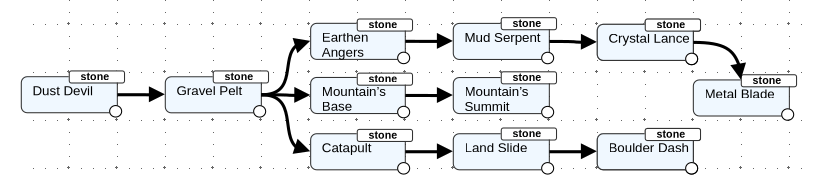
The first spell in the chain is Dust Devil. That means that rune stone is the Dust Devil rune stone. Dust Devil is the only spell accessible to you. However, once you've unlocked Gravel Pelt you can access Gravel Pelt. You can access all the spells connected to Dust Devil, but you have to unlock each one is sequence just like with any skill.
The level that you can reach in the spell depends on the clarity of the rune stone.
- Black: Tier 1 and 2 spells and effects
- Gray: Tier 3 spells and effects
- Silver: Tier 4 spells and effects
- Teal: Tier 5 spells and effects
- Clear: Tier 6 spells and effects
If Dust Devil is in a black stone, then you can only ever get to Gravel Pelt. However, if it is in a Clear stone, then you can get access to all spells of the Dust Devil spell family.
Selling and Buying Rune Stones
Already created rune stones may be available in certain localities and in certain campaigns. The worth and price for these rune stones could be determined by the GM, however, here is a simple way to deal with the values of rune stones.
Ylem stones value differ depending upon their purity.
| Ylem | Crafting Skill Required | Soul Stored | Spell Tier Access | Cost Per Pound |
|---|---|---|---|---|
| Gray Ylem | Novice Runic Crafting | 15 Soul | Tier 3 | 150.00 |
| Black Ylem | Basic Runic Crafting | 10 Soul | Tiers 1 - 2 | 75.00 |
| Silver Ylem | Novice Runic Crafting | 20 Soul | Tier 4 | 225.00 |
| Teal Ylem | Better Runic Crafting | 30 Soul | Tier 5 | 300.00 |
| Clear Ylem | Advanced Runic Crafting | 40 Soul | Tier 6 | 600.00 |
Sorcery and Magic
Sorcery: the use of power gained from the assistance or control of evil spirits especially for divining.
Magic in Nor'Ova is a natural force and a part of every thing in Nor'Ova, from every living person, creature, tree, flower, and insect. The casting of magic spells is in actuality the effect of manipulating a runic element - the natural elements that flow through all life on Nor'Ova. All things born on Nor'Ova are born with the components needed for magic; the possession of a runic soul, the embodiment of a runic spirit, and the runic energy needed to manipulate the element they are connected to.
However, this was not always the case. Before the nuclear apocalypse known now as the Great Magic War that ended the First Era, no sentient creature had developed runic energy. While it is believed all things always had a runic soul and runic spirit, the needed runic energy to connect to the soul and spirit didn't form until the nuclear fallout forever changed the DNA of all living things. However, magic has always existed.
Before people could manipulate the runic elements almost as easily as they could draw breath, only the most trained could cause any form of magical effect. These people were sorcerers, and though they did not fully realize what it was they were doing, they had found ways to offer up components of unique qualities to bend their runic element just enough to cause a magical effect. Many early sorcerers were of course suspected to be drawing power from the demons of Xodod, or even Zodo himself. While in some cases there might have been some truth to this, for the most part, this wasn't always true.
When the people of Nor'Ova could communicate with and manipulate the runic element of their soul, sorcery as an art began to disappear. It however has never truly vanished. Now days skilled mages can turn to sorcery to improve their connection with the elements, giving their magical arts a greater edge to their non-sorcery using rivals.
Using Sorcery
Sorcery is used by first using the ability:
| Ability | Ability Type | Effects | Requirements |
|---|---|---|---|
| Sorcery | 🛠️ Utility Ability |
Allows for use of alchemical ingredients for spell casting. |
N/A |
Having that ability allows the mage to tap into the ancient secrets of sorcery.
Sorcery can help you in many ways. It can lower the stat cost of a spell, or maybe even the action cost. It could increase the damaging, or healing power of a spell. You could add effects to a spell such as poison. You could increase the spell's range or duration. Really, what you can do with sorcery is almost endless. For the well prepared mage, sorcery could prove to be quite a useful skill - if only you have the desire to truly make it work for you and the patience needed to explore the many possibilities.
The way that sorcery can help you is by making use of alchemistry ingredients.
Using Alchemistry Ingredients
With sorcery, you can use the effects of alchemistry ingredients to give the spell different effects. For example, you could use a black cap mushroom to cause the spell to also inflict 2 Vitality poison per round, per mushroom cap used! This means if you were to use 4 of those mushrooms with your spell, your spell would inflict 8 Vitality poison damage per round plus whatever effects the spell also does. Or maybe you'd use a red cap mushroom and have your Vitality healing spell also restore some Endurance. If you were to use any Soul restoring ingredients though, the Soul cost of the spell would decrease instead of restoring Soul.
The number of effects you can use in sorcery and the number of ingredients you can use is determined by the create potion level you have. If say the Mustard Turnip Leaf also provided pain relief, then the combined potion could restore Vitality and relieve pain if you use Level 2 Create Potions. Level 1 Create Potions only allows you to create potions with one (1) effect using up to three (3) ingredients.
The number of ingredients and effects that can be used/applied based on the create potion ability are as follows:
- No Potion Crafting Skill: can use up to 2 ingredients; sorcery can use 1 effect
- Create Potions Lv1: can use up to 3 ingredients; sorcery can use 1 effect
- Create Potions Lv2: can use up to 4 ingredients; sorcery can use 2 effects
- Create Potions Lv3: can use up to 5 ingredients; sorcery can use 2 effects
- Create Potions Lv4: can use up to 5 ingredients; sorcery can use 3 effects
The greater your create potion ability, the more powerful your potions can be. Some ingredients and bases can only be used if you have the create potion ability required or greater. Other ingredients can have their basic effects enhanced by using a higher create potion ability. Such information will be provided by the ingredient or base if it applies.
You can probably already see how this could be a great boon to your spell power. However, as with all things, there are rules.
- You can by default only make use of the First Effect, or the Main Effect if using a base ingredient.
- To make use of other effects, you will need to pickup some potion crafting skills, just like with the potion crafting rules.
- For the most part, sorcery follows the rules of potion crafting with the exception that you are using the ingredients to empower spells instead of make potions.
- Any ingredient that restores Soul will only ever reduce Soul costs, they will never add a restore Soul effect to your spell.
- Action reducing effects can only reduce a spells magic actions and only at a maximum of 1 action, no matter how many ingredients with that effect are used.