
The Active Turn is when you can act. This is the portion of the round when you can move, attack, use skills and spells, and take support actions. Your active turn lasts until you have completed your available actions for the round.
Actions
During your Active Turn you may perform one of each of the following actions. That means one attack, one move, one support action, and one magic action per turn.
- Attack: You can attack once. This can be a simple attack or an offensive skill. Once you have performed an attack action you cannot attack again until the next round.
- Move: You can move once during your active turn, up to your full move rate. Once you stop moving your move action is done — even if you haven't used all of your movement. Simply getting up if you have fallen, or turning without moving, counts as your move action.
- Support: You can take one support action per turn — using a potion, changing equipment, reloading, or using a support-type skill. Once performed, you cannot take another support action that round.
- Magic: You can cast one spell per turn. If the spell's casting speed exceeds your Runic Casting Speed, the spell carries over into subsequent rounds until it is ready. For example, a spell with casting speed 2 cast by a character with Runic Casting Speed 1 takes two rounds to complete.
You may choose to wait and act later in the round, even after a character with a lower initiative. However once you choose to act, any actions you do not use are lost.
The Ruler
All movement, ranges, and areas of effect in combat are measured with a ruler. 1 inch = 1 space, 1 space = 5 foot area. When the rules refer to a number of spaces, count that many inches on your ruler.
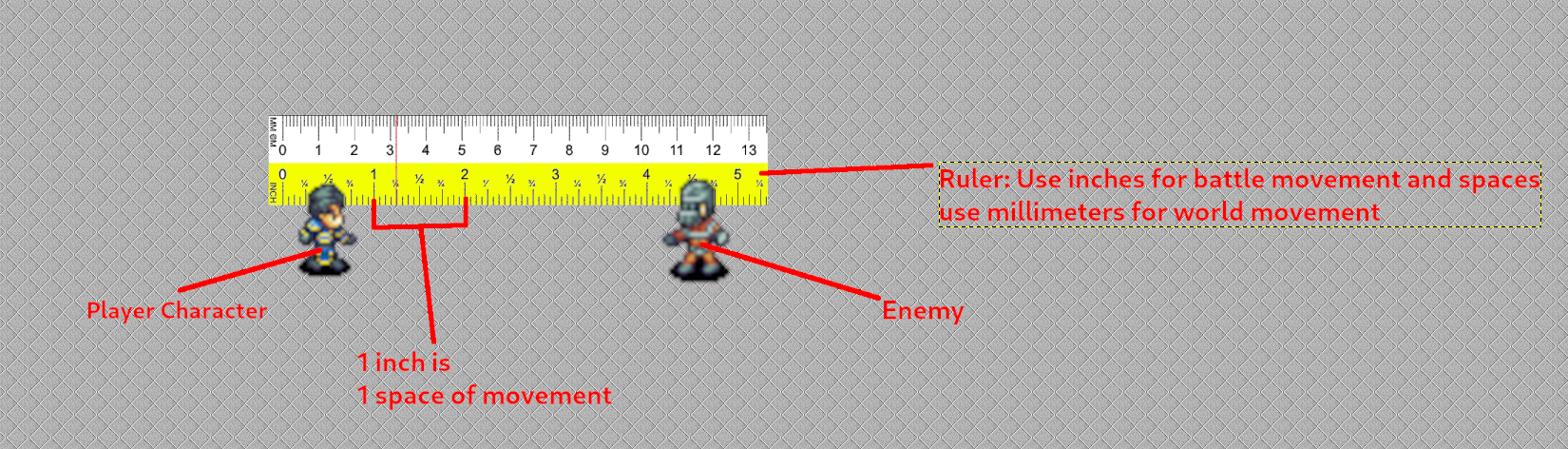
Use the inches side of the ruler. One inch is one space.
Attacking
To attack a target, declare you are attacking and which target you are attacking. You must be within range. No roll is needed to attempt a melee attack — the target may however make an Evade check to avoid being hit, which is covered in the Defensive Turn. Throwing and projectile attacks require a Focus check to hit.
The damage you deal depends on your weapon and attack type.
- Offensive Power is added to any hand-held weapon attack, unarmed strike, or thrown weapon.
- Bow Power is added when using a bow and arrow.
- Dual Wielding lets you use two weapons simultaneously with one attack action. You must have the appropriate dual wielding ability.
- Two-Handed Weapons let you apply Offensive Power twice to the attack.
- Hand Dominance: Attacking with your non-dominant hand adds only ½ your Offensive Power. Bows are always used with the dominant hand and never receive this penalty.
Aided Attacks
You can sacrifice your attack action to attack simultaneously with an ally — adding your attack to theirs rather than attacking independently. Rules for aided attacks:
- You must be within range of the same target your ally is attacking.
- You can use a skill as part of your aided attack.
- You must not have taken your turn yet.
- Doing so uses your attack action for the round; you can still take other actions.
- Your attack is added to your ally's total, increasing their damage for that strike.
- If your ally is performing a multi-attack skill and you are only performing one attack, your attack is added to their first strike. If you are both performing the same multi-attack skill, each of your attacks is added to the corresponding strike.
Criticals
Critical Success applies when using a skill or spell and you roll a natural 20. The point value effect of the skill or spell is doubled and Offensive or Bow Power is doubled for that attack.
Critical Failure applies when using a skill or spell and you roll a natural 1. Roll a 1d6 to determine the outcome:
- Roll 1: Despite the failure, the skill or spell somehow works anyway. A lucky break.
- Roll 6: The worst possible outcome. The skill or spell does the opposite of what was intended — healing an enemy, harming an ally, or backfiring on the caster. The GM determines the exact effect.
- Roll 2–5: A straightforward failure with no additional effect.
Critical Hits are separate from critical success and failure. You get a free critical hit check with every physical attack. Make a Critical check — in most cases a Normal difficulty check. If you succeed, double your Offensive or Bow Power for that attack.
Your Offensive Power is 2 + 1d6.
Normal hit: 2 + 1d6
Critical hit (success): 4 + 2d6 (Offensive Power doubled)
Critical hit (natural 20): 6 + 3d6 (Offensive Power tripled) + 1d6 roll for instant kill on a 6
Critical Critical Hits
Rolling a natural 20 on a critical hit check is the ultimate outcome:
- Deathblow Chance: Roll 1d6. On a 6 the target is instantly killed — even if fully defending or blocking.
- Epic Casting: If the natural 20 is on a spell's critical hit, roll 1d6. On a 6 the target is instantly killed or fully restored (depending on spell type) — ignoring immunity and magical protection.
- Double Crit: If a 6 is not rolled, the hit is a double crit. Offensive, Bow, or Runic Power is added three times instead of two.
Offensive Power + Offensive Power + Offensive Power + Weapon Attack Value + Skill Attack Value
Critical Failure of a Critical Hit
Rolling a natural 1 on a critical hit check means no damage is dealt at all. If a skill or spell was also being used, the critical mishap rules apply instead.
Rolling Critical With Trait Checks
Critical results also apply to trait checks and saving throws:
- Critical Success (natural 20): Automatic success regardless of difficulty. The GM may add bonus effects — a permanent +1 to the relevant trait, double the distance thrown, and so on.
- Critical Fail (natural 1): Automatic failure regardless of your final score. The GM may allow a follow-up Luck check to see if you get lucky anyway.
Rolling Critical with Saves
Save throws — Vitality, Soul, or Power — can also produce critical results:
- Critical Success Save (natural 20): Automatic success, and you recover 20% of your maximum stat. If the save had a cost, the cost is waived.
- Critical Fail Save (natural 1): Automatic failure, and you cannot attempt the save again next round. For Power or Soul saves you also lose 20% of your full stat. For Vitality saves you are automatically dead and can only be revived by spell.
Melee Attacking
Any attack where you physically strike a target at close range — with hands, feet, or a held weapon — is a melee attack. Offensive Power is always added to melee damage.
Armed: Offensive Power + Weapon Attack Value
Armed with skill: Offensive Power + Weapon Attack Value + Skill Attack Value
Armed with skill (critical hit): Offensive Power + Offensive Power + Weapon Attack Value + Skill Attack Value
Throwing Attacks
Throwing attacks follow the same formula as melee attacks, adding Offensive Power to the weapon's damage value. A Focus check is required to hit.
Throwing (critical hit): Offensive Power + Offensive Power + Weapon Attack Value + Skill Attack Value
Projectile Attack with Bow & Arrow
Bow attacks use Bow Power instead of Offensive Power and combine both the bow's and arrow's attack values. A Focus check is required to hit.
Bow (critical hit): Bow Power + Bow Power + Bow Attack Value + Arrow Attack Value + Skill Attack Value
Focused Attacks
If a target has a high Evade or you want to increase your odds of hitting, you can make a Focus check as a support action. Roll 1d20 and add your Focus trait. If you succeed, reduce the target's Evade by your Focus trait value + 1 (minimum 1). This makes the target harder to evade but not impossible.
| Difficulty | Situation | Must Roll |
|---|---|---|
| Easy | Clear line of sight, target is distracted or not facing you. | 10 or greater |
| Normal | Standard face-to-face attack. | 15 or greater |
| Hard | Target is aware and facing you; smaller or harder to hit; you are distracted or have visual instability. | 20 or greater |
| Impossible | You are blinded or can barely see the target; target is also small or hard to hit; heavy distractions. | 25 or greater |
Focused attacks count as a support action. Some profession abilities automatically apply a focus penalty to a target's Evade — those are free and do not cost a support action.
Facing Direction
You can only attack to your front unless a skill states otherwise. Your identifier on the battle map must have a distinguishable front side so everyone can see which direction you are facing. Attacking from the side or behind gives the attacker an advantage because the defender has less time to react.
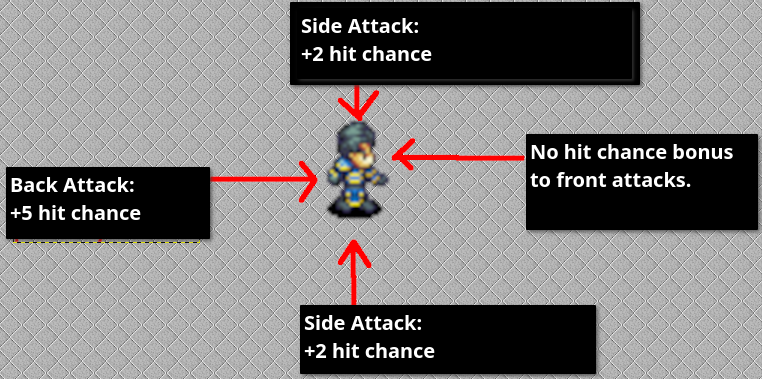
Front attacks carry no modifier. Side attacks give the defender −2 to Evade. Rear attacks give the defender −5 to Evade. The same penalties apply when you are attacked from those angles.
Dealing With Hidden and Covered Targets
If you cannot see an enemy you cannot attack them — unless you have a skill such as Blind Shot. You must first make a Perceive check to spot a hiding enemy, applying any difficulties and penalties the GM sets.
If an enemy is behind an obstacle they are considered covered. You must be on the same side of the obstacle as the enemy to attack them. You cannot hit a target beyond or through an obstacle unless using an area of effect skill or spell that extends past it, at GM discretion.
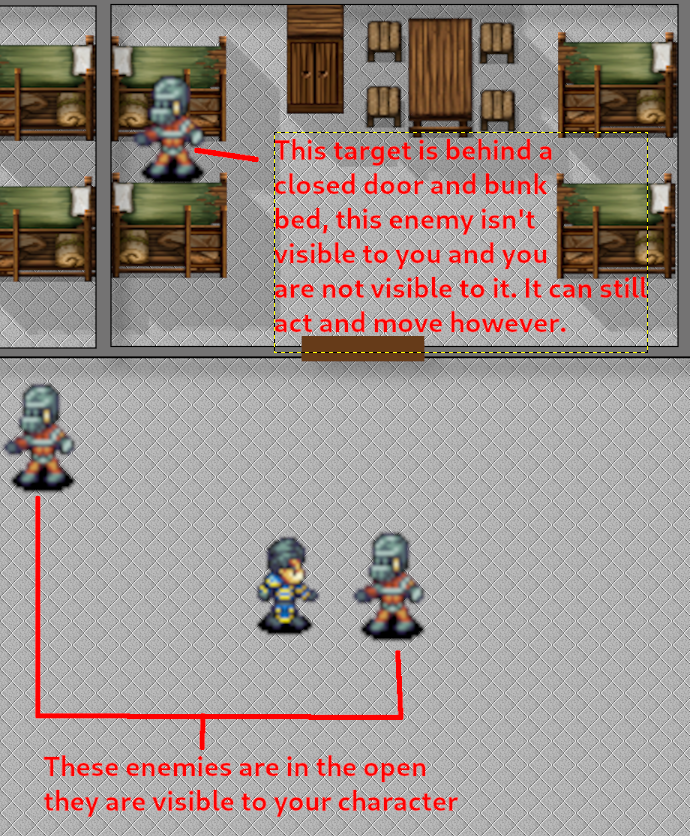
Covered targets require you to be on the same side of the obstacle. Hidden targets require a Perceive check before you can attack.
Using Skills and Spells
Using a skill or spell is straightforward: make the success roll, describe what the skill or spell does, and apply the results. You spend the action cost and stat cost whether you succeed or fail. Minor elemental manipulations can be used freely.
The most important thing to understand is area of effect. If a skill or spell covers a 1×1 space area around the user, measure 1 inch on your ruler in all directions from your identifier - anything within that radius is affected. Scale accordingly for larger areas.
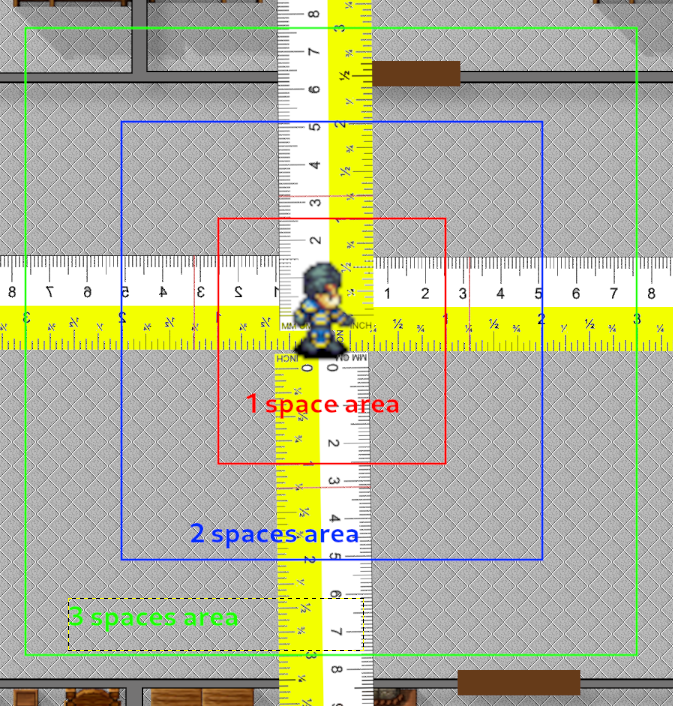
Tabletop: measure from your identifier outward in inches.
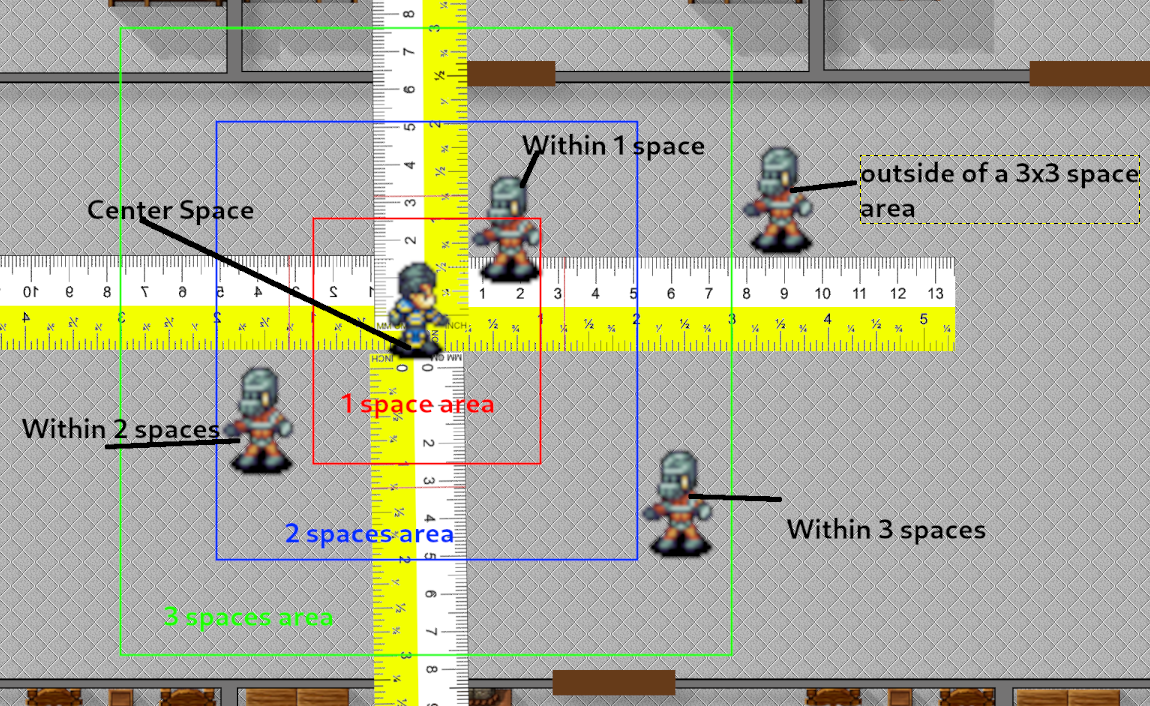
Red = 1×1, Blue = 2×2, Green = 3×3 space areas.
Targets within the area of effect are affected. Targets outside it are not. Walls and solid obstacles may block an area of effect even if a target is technically within the measured range, especially for spells that require line of sight.
Magic
Like attacking, you can only cast one spell per turn unless you have an ability such as Quick Magic. Once you have cast or attempted to cast a spell, your magic action is used for the round. Magic skills can be combined with spell casting as long as they add to or modify the spell being cast.
Aided Magic
You can sacrifice your magic action to cast a spell simultaneously with an ally, adding your spell's power to theirs. Rules for aided magic:
- You must be within range of the same target your ally is targeting.
- Magic skills cannot be added to an aided cast unless they specifically state they apply during the casting of a spell.
- You must not have taken your turn yet.
- Doing so uses your magic action for the round; you can still take other actions.
- Your spell is added to your ally's, increasing their total.
- You and your ally cannot be of opposing elements.
- The spell type must match — both healing, or both damaging.
Focused Magic
If a target has a high Evade or you want to increase your odds of hitting with a spell, you can make a Focus check — the same as a Focused Attack. Roll 1d20, add your Focus trait, and reduce the target's Evade by your Focus trait value + 1 on a success. This is a support action and uses the same difficulty table as Focused Attacks above.
Movement
You can move once during your active turn, up to your full battle movement rate. Once you stop, your movement action is done for the round — even if you haven't covered your full rate. Stopping to attack does not let you resume moving afterward.
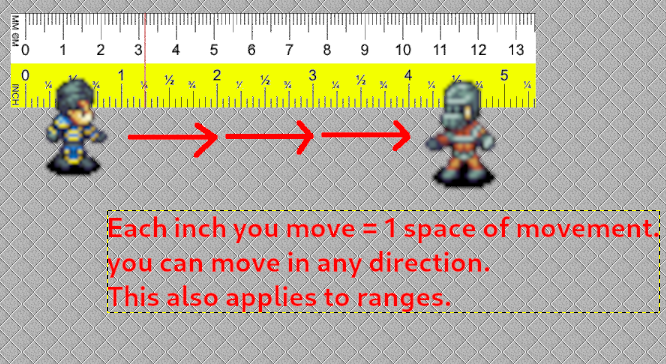
Move your identifier along the ruler. Each inch is one space of movement.
Sprinting
Every character can sprint. Sprinting lets you move at double your battle movement rate at a cost of 2 Power per use.
Crawling
Crawling lets you move while staying low to the ground — useful for staying behind cover. Crawling moves you at half your movement rate.
Flying
Flying characters move at three times their movement rate and can cross most obstacles. However, flight isn't always possible — check with the GM that the environment allows it before declaring a flying move. Characters who can't fully fly may still be able to glide or use wings for a smaller movement bonus; check with the GM.
Obstacles
Battlefields are rarely empty. Water, debris, stairs, pit holes, trees, and rubble all present movement challenges. When climbing or swimming is required, refer to the climbing and swimming rules in the Gameplay Basics & Exploration section.
Attack of Opportunity
Moving during your active turn can trigger an Attack of Opportunity — a chance for a nearby enemy to strike you as you move. An Attack of Opportunity can be triggered when:
- You move away from an enemy who attacked you (or vice versa).
- You move within or across an enemy's range while they are facing you (or vice versa). This includes jumping and flying.
If triggered, the character makes a hit check. If it succeeds, they attack and the moving target must stop at the point of the attack, ending their movement for the round. Skills can be used in an Attack of Opportunity but not spells — the attack is too sudden for spellcasting.
Support Actions
You can take one support action per active turn. Support actions include:
- Using an item: Getting and using a potion counts as a single support action. To use a potion on an ally you must be within 1 space and facing them. Throwing a potion to an ally uses your attack action instead; every target in the path can make a free React check to catch it, and the first to catch it gets the item.
- Changing equipment: You can change as much equipment as you want in one support action, but once you stop you cannot change more until the next round.
- Reloading: Required for most projectile weapons unless the weapon states otherwise.
- Support-type skills: Any skill designated as a support action.
- Focused attacks or magic: Making a Focus check to reduce a target's Evade costs a support action.
Each of these costs exactly one support action. You cannot take two support actions in one turn.