Introduction
"We did not invent these gods. We only learned to read their names. Every spell ever cast was a prayer, whether the caster knew it or not."
— from the Founding Address of the Council of the Anointed, Phercia
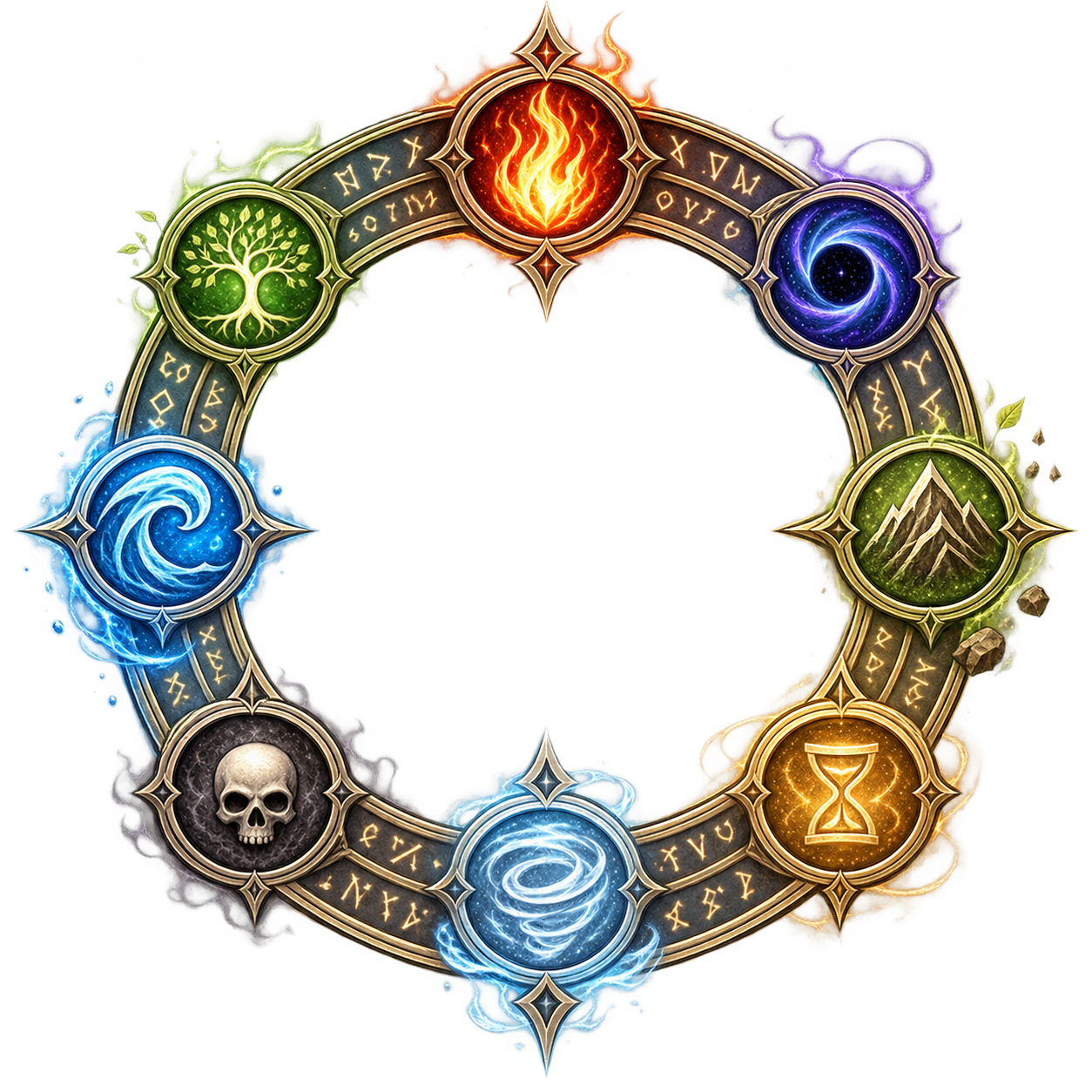
The Church of Mana is the youngest of Nor'Ova's great faiths, and in the Kingdom of Auphera, the most powerful. It holds that the sixteen pairs of runic symbols are gods in their own right, and that magic itself is the living body that joins them. Born from the halls of the College of Arcana barely thirty years ago, it became Auphera's state religion within five. Whether it is a revelation, a philosophy that outgrew its scholars, or something its own priests do not fully understand is still argued in every tavern in Phercia.
The Church teaches that the ring is complete in itself: Mana is the whole circle, not any point within it. Its priests do not speak of the empty center, and turn the conversation when others do. Older scholars, who remember another holy symbol built around a flame, have drawn their own conclusions.
Doctrine
The Church teaches that the runic symbols are not names scholars gave to magic, but the true names of gods. Each affinity is one divine being with two faces: the Sun and the Volcano are the same god seen in warmth and in wrath, as Memory and Rumination are one god of the past, kind and cruel. Mana is what the Faithful call the whole: magic itself, the body that joins the sixteen.
From this the Church draws its central teachings:
- Every spell is a prayer. To cast is to call on a god by name, whether the caster believes or not. The Faithful cast knowingly, and the Church holds that the gods answer them more fully for it.
- The faithful are recognized. Magic favors those who honor it. The Church points to its priests' spells as proof: brighter, steadier and stronger than any cast outside the faith. Critics at the College of Arcana note that many of the founders were the College's finest spell crafters, and ask whether the gods' favor was crafted.
- The other gods are misunderstood symbols. Kymara, El Anon, Norvus and the rest are not false, the Church says, only mistaken: they are the sixteen seen through older, narrower eyes. Kymara's resurrections, to the Faithful, are simply the work of the Spirit and the Soul.
- Conversion is a mercy. Those who pray to the wrong names still pray to Mana, but badly. To bring them to the true names is a duty, and the Faithful pursue it with sincere and often uncomfortable zeal.
The Church says little about where magic comes from. Asked whether the sixteen came from something before them, its priests answer that the body needs no father. Whether that is faith or avoidance, in a kingdom where one particular answer is against the law, is a question many scholars have been careful not to ask aloud.
The Council of the Anointed
The Church has no single head. It is led by sixteen Anointed High Priests, one for each god, who sit together as the Council of the Anointed in the Grand Cathedral of Mana. Each priest is said to carry both faces of their god, and the Faithful speak of them as living halves made whole. Decisions require a majority of the sixteen; on matters of doctrine, tradition demands that every element be heard before a vote.
|
Element |
Affinity |
Anointed High Priest of… |
|---|---|---|
|
Earth |
Stone |
the Mountain and the Crevasse |
|
Earth |
Nature |
Ova and the Faerie |
|
Air |
Air |
the West Wind and the Tornado |
|
Air |
Sound |
the Siren and the Banshee |
|
Water |
Water |
the Sea and the Glacier |
|
Water |
Desert |
the Desert and the Oasis |
|
Fire |
Flame |
the Sun and the Volcano |
|
Fire |
Light |
the Star and the Fire |
|
Life |
Energy |
the Seraphim and the Nephilim |
|
Life |
Spirit |
the Spirit and the Soul |
|
Death |
Death |
Pain and Serenity |
|
Death |
Decay |
the Worm and the Fade |
|
Time |
Past |
Memory and Rumination |
|
Time |
Future |
Fate and Doom |
|
Space |
Mind |
Dream and Nightmare |
|
Space |
Fear |
Presence and Dread |
An Anointed High Priest is chosen from the faithful mages of their god's affinity, and is expected to be among its most powerful casters. The title is held for life, and a seat is filled only when its priest dies. The faith is young enough that no seat has yet passed to a second holder, and the Council has never settled how one would be chosen. Many expect that day to be the Church's first real test.
Two seats draw questions. Ova and the Faerie names a goddess with her own temples, which her followers take as an insult; and the Spirit and the Soul has unsettled more than one scholar, since those are words older faiths use for parts of Zodo. The Church answers that older faiths borrowed the names, not the other way around.
The names of the sixteen are public record in Phercia, though few outside the Church could recite them.
A Brief History
About thirty years ago, nearly half the scholars of the College of Arcana declared that their study had become worship. What began as a debate in lecture halls became a schism, then a congregation. Five years later, King Cadimus Mercleis X converted and made the Church of Mana the state religion of Auphera, the first in a kingdom whose Temple of Arameas had long taught that no faith should be forced by law.
The Crown gave the Church the Grand Cathedral of Kymara in Phercia, now the Grand Cathedral of Mana. The Church of Sol Anon protested publicly and demands recompense to this day. In the years since, the Church's attention has turned to the Angerians of Auphera's coasts, long revered as angelic: if the Seraphim and the Nephilim are gods, what then are a people who claim to carry their blood? The Church's answer has been simple. Angerians who join the Faithful are welcomed as living proof of the gods. Those who refuse are another matter, and the stories coming from the coast suggest the Church's patience is wearing thin.
Worship and Practice
- Sacred casting. Services are led in spells rather than sermons. Each rite calls on one of the sixteen by name, cast by a priest of that affinity.
- Spell crafting as devotion. The Church's priests craft their own sacred spells, and these are said to be unmatched outside the faith. To the Faithful, a well-crafted spell is an offering.
- The sixteen feasts. The Church keeps a holy day for each god, and the full cycle of sixteen marks the Church's year.
- Conversion. Missionaries travel with the Crown's blessing. Most rely on demonstration: a spell cast in a god's name, and an invitation to learn it.
The Church and Other Faiths
The Church does not call other gods false, only misunderstood. Its missionaries are courteous and patient, which makes them harder to refuse. Followers of Kymara and the Church of Sol Anon are its sharpest critics; the Temple of Arameas has protested the state religion on doctrine; and Zodo's faithful, already outlawed, are watched more closely since the Church rose.
The Church and the Awakened
The Awakened, who wake from the Dark Paralysis speaking of dreams, are pitied and feared across Auphera. The Church of Mana is one of the few places they are welcomed. Many find in it something they recognize: a lawful, ordered worship of the power that speaks to them in their dreams, the one they call Taal Zodo.
It is whispered that some of the Anointed High Priests are themselves Awakened. The Church neither confirms nor denies it. If it is true, one has to wonder whom they believe they pray to, and whether the rest of the Council knows.