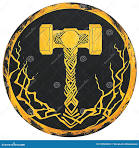
1In the beginning, before Zodo, before the elements, before even time itself - there was El Anon. 2El Anon looked upon nothing, and with but a hammerstroke against the Forge he created everything.
The Book of Origins 1:1-2, The Holy Design
El Anon is the Creator. He is the god who brought the universe into being - who made Zodo, who made the other gods, who made Nor'Ova and all of existence as it is known. He is, by any theological reckoning, the most powerful being in the pantheon. He is also, paradoxically, the least present.
El Anon created and then stepped back. He watches over his creation, intervenes only when it is threatened as a whole, and delegates the management of individual aspects of the world to the gods he made for that purpose. This approach - if it can be called an approach rather than simply his nature - has been the source of considerable theological frustration across the eras. A creator who will not intercede. A god whose power is absolute and whose involvement is minimal. Believers struggle with this. Skeptics point to it as evidence that El Anon either does not exist or does not care. His most devoted followers argue that his restraint is itself an act of profound love - that to intervene constantly would be to deny his creation the free will he gave it.
Characteristics
7To see yourself is to see El Anon, for the master forger crafted all in his divine likeness.
The Book of Faith 2:7, The Holy Design
El Anon is neutral in alignment - genuinely, fundamentally neutral.1 He does not concern himself with morality, good, or evil as mortals understand those terms. He cares about two things: creation itself, and free will. To El Anon, the act of creating is sacred in every form it takes. Whether that creation is a cathedral or a weapon, a song or a plague, what matters is that something was made where nothing existed before.
Prophets who have dealt directly with El Anon - a small and remarkably consistent group across the eras - describe him as aloof. His followers, by contrast, tend to describe him as strict and rigid. This disparity is itself telling: those closest to him experience distance; those who follow at a remove experience structure. It is possible both are accurate.
Personification
El Anon most commonly appears - when he appears at all - as an elderly figure with a long gray beard and flowing robes.2 Few who have actually looked upon him directly have survived the experience, or at least survived it intact. He is described as radiant with power in a way that is not metaphorical - to be in his presence is to be in proximity to the source of all creation, and that proximity has consequences.
Unlike Zodo, El Anon has never needed a host or a vessel. He is not separated or diminished. He simply chooses not to be present most of the time, which theologians have spent considerable effort distinguishing from being absent.
Powers
19"To which does the power belong, to the forge and the hammer, or to He who wields them", thus spoketh El Anon.
The Book of Law 3:19, The Holy Design
El Anon's power is creation - true creation, the bringing of something into being from nothing. This is categorically different from Zodo's power, which is change and destruction. Zodo can transform what exists; El Anon can make what does not yet exist. Scholars of comparative theology tend to agree that creation is the higher power of the two, though they note with some discomfort that this has not prevented Zodo from being significantly more active and influential in the day-to-day experience of Nor'Ova.3
El Anon used his power of creation to make the universe, to make Zodo as his forge, and to make the other gods as stewards. He also, at some point, made Kymara - the Sol Anon - as his direct offspring, which places her in a unique position within the pantheon as the only deity who is simultaneously the child of El Anon and has walked among mortals in mortal form.
Followers
8Do not fear my absence, for I am always with thee.
The Book of Faith 2:8, The Holy Design
There was a time when El Anon's followers outnumbered all others on Nor'Ova. That time has passed. The rise of the Church of Sol Anon drew the majority of his followers toward Kymara - his own daughter - and the Church of the Holy Body took many of the rest. What remains of dedicated El Anon worship is fragmented into several groups, of which the most prominent and most controversial is the Ardathians. The great exception is the dwarves, nearly all of whom revere El Anon as the Great Father, the master smith whose forge made the world. Their worship is less a church than a way of life, and it has little patience for the Ardathians' zeal.
The Ardathians
The Church of Saint Ardatha, commonly called the Ardathians, is a passionate and by most accounts extreme group of El Anon believers whose stated purpose is to rid Nor'Ova of all other religions. They hold that El Anon is the one true creator and that the worship of any other being - including Kymara, whom they regard as a mortal prophet rather than a goddess, and certainly including Zodo - is a corruption of the world El Anon made. They share some textual heritage with the early Church of Sol Anon, and the two groups have a long, bitter, and occasionally violent history of mutual accusation and doctrinal dispute.4
The Church takes its name from Saint Ardatha, whose devotion to El Anon was matched only by his intolerance of every other faith. The deed that made him a saint to his followers is the same one that makes him a villain to nearly everyone else: when a town refused to abandon its faith in Zodo, Ardatha burned it to the ground. Ardathians remember him as the one who did what El Anon would not. Others ask why a creator who values free will above all things has never once spoken against those who kill in his name.5
In the years before the Great Magic War, when open zeal was treated as terrorism, Ardathians kept all but their declarations to El Anon hidden. It is widely suspected, though never proven, that the cult which murdered Kileen - the mortal incarnation of Kymara, whom Ardathians insist was never a goddess at all - was Ardathian.6
The Temple of El Anon
The Temple of El Anon is the older and quieter of El Anon's faiths, and in many ways the Ardathians' opposite. Where the Ardathians would purge the world of other gods, the Temple holds that El Anon made all things - including the other gods - and that honoring the Creator means honoring what he made. Its teaching centers on the two things El Anon is said to value most: creation and free will. To the Temple, a well-made tool, a raised barn, or a child carefully taught are all acts of worship, and forcing faith upon another is among the gravest offenses against the Creator, since it steals the very freedom he gave.
Temples of El Anon are as often workshops as sanctuaries, and their priests are frequently craftsmen first. The faith is strongest among the dwarves, whose holds keep temple-forges where the Great Father is honored with hammer and anvil rather than with sermons. The Temple and the Ardathians share the Holy Design, and very little else.7
Clerics of El Anon
Priests of El Anon follow what they call the righteous order of creation. To them, all forms of creation are sacred - including artificial creation, runic crafting, and even magical constructs. Their power manifests through their aura: the higher their aura, the more those around them - in a three-by-three space - find themselves growing calm, their agitation and hostility settling into something quieter. Anything a priest of El Anon creates is also simply better - crafted with a precision and intentionality that seems to exceed what their skill alone would produce, as though El Anon's creative power is lending its weight to the work.8
Theological Notes
El Anon's relationship with Zodo presents the central unsolved problem of Nor'Ovan theology. El Anon created Zodo. El Anon knew, presumably, what Zodo was capable of. The corruption of Zodo, the suffering it produced, the Great Magic War, the separation of Zodo, the ongoing influence of the Soul of Zodo on the world - all of this traces back to a being that El Anon made. The question of why El Anon made Zodo the way he made him, and why he has not intervened more decisively in the consequences, is one that every major faith on Nor'Ova answers differently.
Those who argue against El Anon's goodness rarely need to invent anything; they point to what is recorded. He sealed the Soul of Zodo in Xodod with the help of Zodo's own son, then answered that son's plea for death by giving him charge over it instead. When the Dweller Elves emerged from beneath the earth after the Great Magic War, it was El Anon's celestial servants who met them with swords of fire, condemning them for accepting shelter from the only god who answered them. And his most zealous followers have burned towns in his name without a word of rebuke from him. His defenders answer that a creator cannot be judged by the standards of his creations. His critics answer that this is precisely what a guilty god would say.
The Church of Sol Anon teaches that El Anon sent Kymara as his answer - that rather than unmake what he had made, he chose to redeem it. The Ardathians teach that El Anon's apparent inaction is a test of faith and that those who remain loyal will be vindicated. The Church of the Holy Body, naturally, teaches that there is no problem to solve - that Zodo is the one true god and that El Anon's role in the story is considerably smaller than the other churches claim.9 None of these answers fully satisfies, which is perhaps as it should be.
- 1. His neutrality is sometimes described by Ardathian scholars as "above morality rather than indifferent to it" — a distinction they consider important and most others consider semantic.
- 2. This appearance is consistent across accounts from wildly different cultures and time periods, which either suggests it is accurate or that the accounts have influenced each other.
- 3. Zodo's followers use this point frequently in theological debate, usually to great effect.
- 4. The question of whether Kymara is a goddess or a mortal prophet is the single most contested theological question in Nor'Ovan religious history, producing more written argument than any other topic.
- 5. El Anon's silence on the matter is cited by Ardathians as approval and by everyone else as indifference. Neither interpretation flatters him.
- 6. If true, it would mean that Saint Ardatha's church has killed the very being it denies. Ardathians do not discuss this.
- 7. The Temple regards Saint Ardatha as a cautionary tale. The Ardathians regard the Temple as proof that El Anon's faithful have gone soft. Both consider the other a misreading of the same scripture.
- 8. Skeptics attribute this to the placebo effect of deep conviction. Priests of El Anon tend not to engage with this argument.
- 9. Incantation 3 of the Incantations of Genesis states that El Anon "grew jealous of Zodo" — a characterization that the Church of Sol Anon, the Ardathians, and most independent scholars reject as self-serving revisionism on the part of Zodo's followers.