"Other kingdoms were raised. Chaladonia was inherited. Every stone of this land remembers the Empire, and we are sworn to see that it never forgets."
— King Lucan Xerxes, upon his coronation
The Kingdom of Chaladonia is the second largest nation in Chalcephera, stretching across the continent's northwest from the frozen shores of the Aech Ocean to the edge of the Parallax Desert. It is an old kingdom built on older ground. Chaladonia holds the heartland of the Nor'Ovan Empire, and the ruins of Xenopolis, the Empire's last capital, still stand within its borders, alongside the far more ancient remains of the Askian Empire. Few nations cling to the past as fiercely. Chaladonia is a kingdom of ancient houses, solemn ceremony, and traditions so old that few remember where they began.
It is also a kingdom under strain. Farmland is scarce and fiercely guarded, raiders press constantly against the Stone Curtain in the east, and the Dark Paralysis has struck Chaladonia harder than any other nation. Its King and Crown Prince now lie among the sleeping. In recent years, Chaladonia has closed its borders to the rest of the world, and those few who still travel its roads speak of a nation that watches every stranger closely.
Size
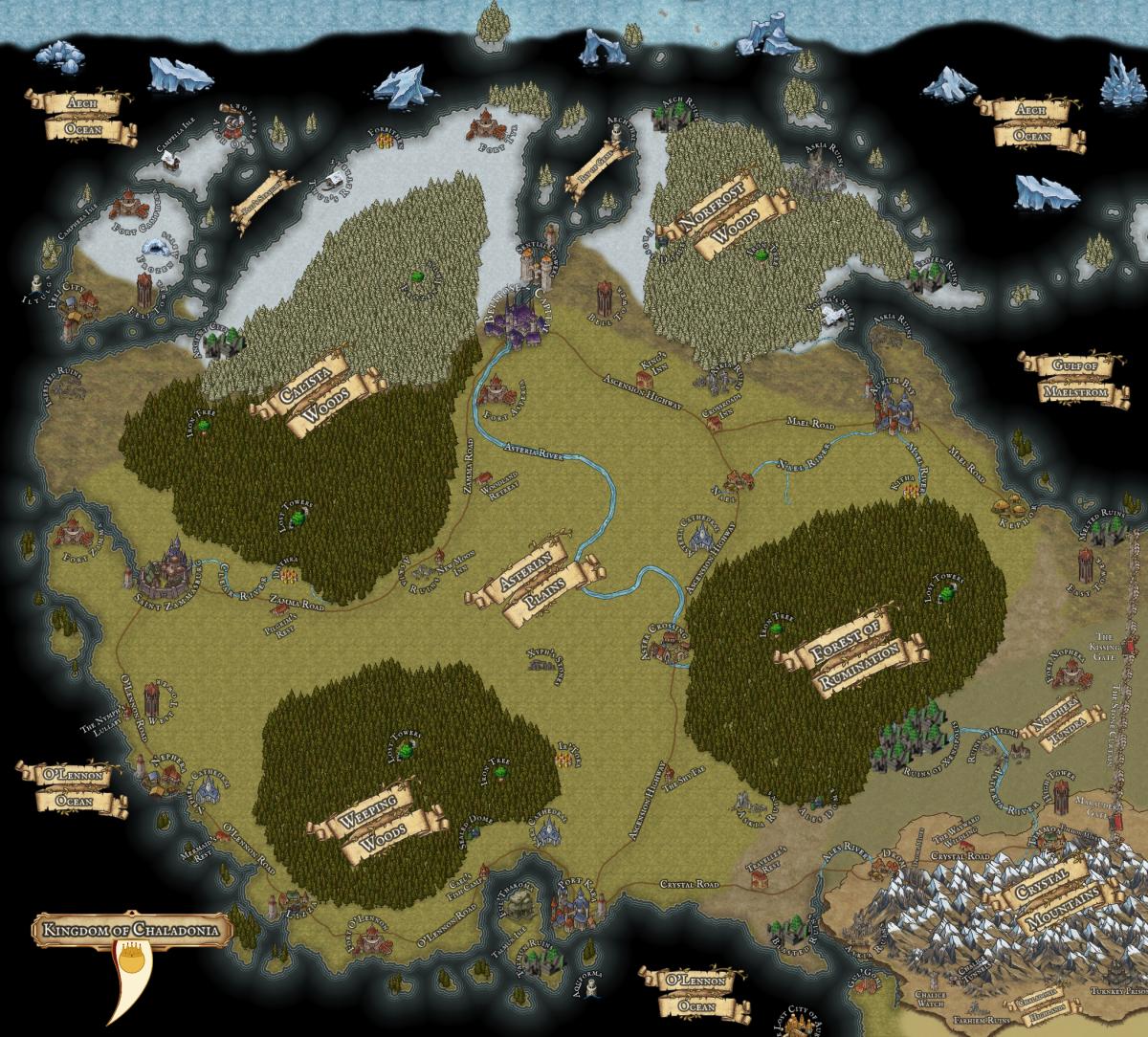
The Kingdom of Chaladonia stretches roughly 1,621 miles from north to south and 1,024 miles from west to east.
Climate
Chaladonia is a cold kingdom, and it grows colder the farther north one travels. Along the shores of the Aech Ocean, winter holds the land for more than half the year. The straits freeze, icebergs drift past the northern forts, and the snow along the coast of Feli and northern Aurum rarely melts entirely, even in summer. The great pine forests of the north, the Calista and Norfrost Woods, thrive in the cold where little else will grow.
The heart of the kingdom is gentler. The Asterian Plains enjoy warm, if brief, summers, and the Asteria River keeps them fertile. But the growing season is short, early frosts are common, and a single cold spring can ruin a year's harvest. It is the reason Chaladonia's farmland is so precious, and why the kingdom has never been able to feed itself as well as it would like.
To the east, the land turns harsher. Beyond the forests, the Norphera Tundra stretches toward the Stone Curtain, cold, dry, and scoured by winds that sweep down from the Northern Wastes. In the southeast, the Crystal Mountains hold snow year-round at their peaks.
The south is the mildest part of the kingdom. Warmed by the O'Lennon Ocean, the coast of Kara and Zamma sees milder winters and longer summers, with frequent rain and sea fog rolling in off the water. Even here, though, winter comes early, and the dry winds that blow up from the Parallax Desert along the southern highlands are a reminder of how close the kingdom's borders lie to far less forgiving lands.
Government
Chaladonia is a hereditary monarchy ruled by House Xerxes, which claims unbroken descent from Killian Xerxes, the last Emperor of Nor'Ova. Within Chaladonia, the claim is beyond question. Outside it, scholars and rival courts have long whispered that the bloodline is a convenient fiction, a name taken centuries ago to lend an old family the weight of empire. House Xerxes has never deigned to answer.
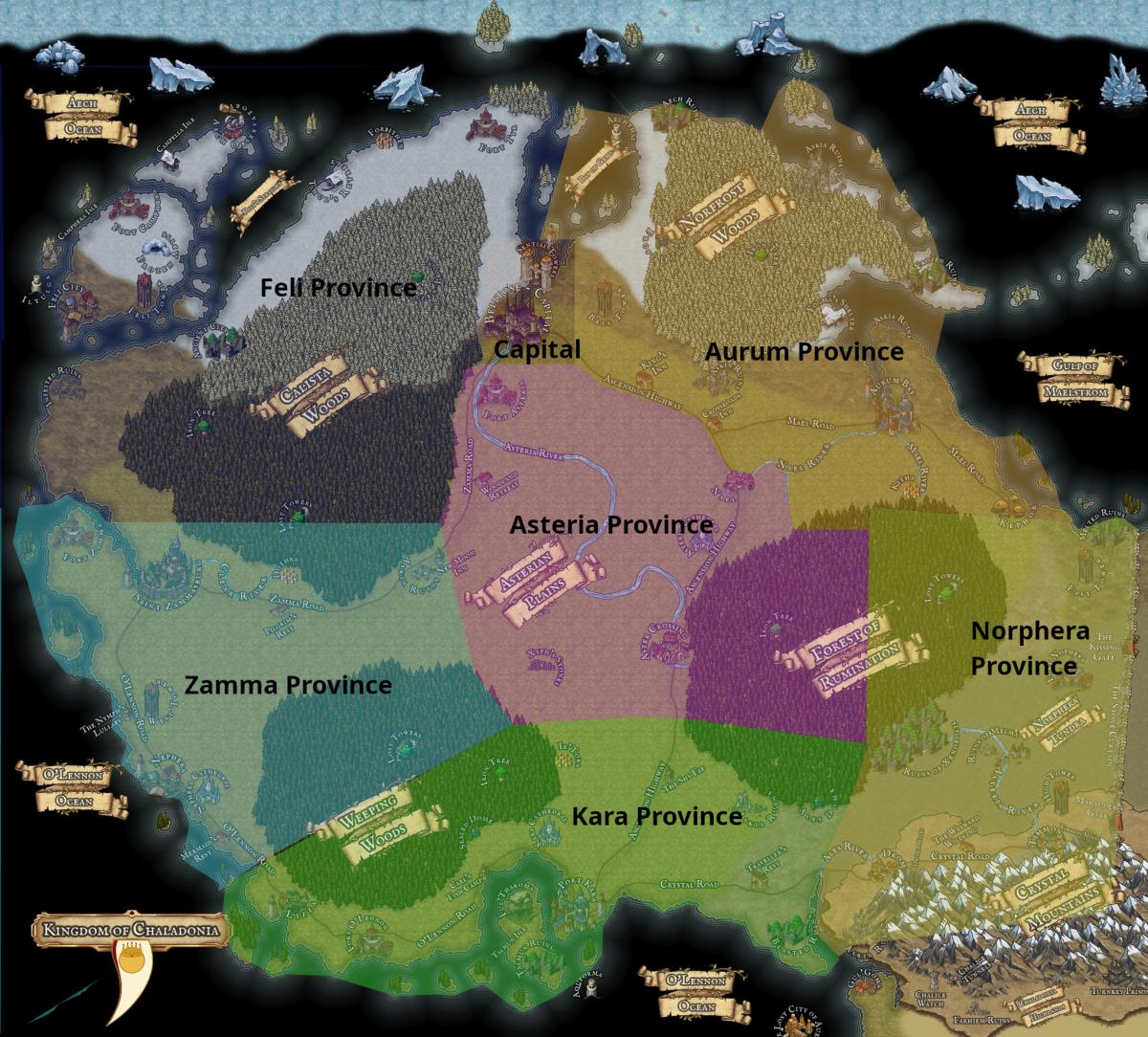
Beneath the crown, the kingdom is divided into six provinces, each ruled by a noble house: House Feli in Feli Province, House Mael in Aurum, House Asterion in Asteria, House Nemaris in Zamma, House Talmur in Kara, and House Melma in Norphera. The head of each house sits on the House of Lords, which advises the crown and governs the kingdom's affairs in its name. The capital, Belitose, belongs to no province. It and its surrounding lands are the King's Land, held directly by the crown.
For now, the House of Lords rules alone. King Lucan Xerxes and Crown Prince Ian Xerxes have both fallen into the Dark Paralysis, leaving the line of succession stalled and the throne empty in all but name. Queen Campella remains at court, a figure of mourning who holds no power of her own, though some at court murmur that the Queen listens far more closely than a grieving widow ought to. In the meantime, the six lords govern together, and the kingdom waits to see how long their unity will hold.
Regions
The King's Land
The capital of Belitose and its surrounding lands belong to no province. Held directly by the crown, the King's Land is the seat of House Xerxes and the meeting place of the House of Lords. Guarded by the Sentinel Towers at the edge of the frozen north, Belitose is the oldest continuously ruled city in the kingdom, and its palace halls are thick with the ceremony Chaladonia is known for.
Feli Province
The frozen northwest, a land of cold coasts, ice-choked straits, and the dense pines of the Calista Woods. Feli's wealth comes from lumber and the sea, and its people are as hardy as the land they work. House Feli is older than the province that bears its name. The family gave its name to Feli City, and the city gave its name to the province. Deeply traditional, the Felis prize hard work above all else, and they hold to old superstitions that the southern houses find quaint, though few southerners would dare test them on a Feli ship. Fort Camphera and Fort Tyr guard its northern shores.
Ruler: Lady Ingrith Feli, a weathered matriarch who still sails with her fleets and won't launch a ship on an ill-omened day.
Aurum Province
Long the richest province in the kingdom, Aurum takes its name from the deposits of aurum, Nor'Ovan gold, found along the inlet where Aurum Bay was built. Beyond its gold, the province supplies whale oil, seafood, and furs from the Norfrost Woods. House Mael is a family of old money and older pride, long convinced of its own superiority over the other houses, and quick to remind them who has filled the crown's coffers for generations.
Ruler: Lord Cassius Mael, polished, wealthy, and certain the kingdom would collapse without Aurum's coin.
Asteria Province
The breadbasket of a kingdom always hungry for more bread. The Asterian Plains hold more farmland than any other part of Chaladonia, watered by the Asteria River, yet the harvest never seems to be enough. Asteria remains the most feudal of the provinces, its lands worked by tenant farmers bound to their lords. Its eastern reaches give way to the dark Forest of Rumination, which the farmers of the plains are careful to keep at a distance. House Asterion knows exactly how much the kingdom depends on its fields, and its ambitions have grown to match.
Ruler: Lord Darius Asterion, ambitious and patient, the lord who feeds the kingdom and knows it.
Zamma Province
The pilgrim west, home to Saint Zammasburg and the oldest surviving cathedral of the Church of Sol Anon, seat of the Hierarch himself, Ambrose Calder. Pilgrims travel the Zamma Road from every corner of the kingdom to pray there. House Nemaris stands apart from the other great houses. While most of Chaladonia's nobility belong to the Church of Chaladonia, House Nemaris remains a staunch follower of the Church of Sol Anon and the Hierarch's most loyal ally on the House of Lords.
Ruler: Lady Seraphine Nemaris, devout and sharp-eyed, the Hierarch's voice on the House of Lords.
Kara Province
The southern coast, rich in fishing, shipping, and the textiles woven in its port towns. Port Kara is its heart, and Fort O'Lennon guards its western shores. House Talmur claims descent from the ancient Askian Empire, a lineage far older than even the crown's. That the Talmurs are not elven has never troubled them, though it has given their rivals plenty to whisper about.
Ruler: Lord Oren Talmur, a scholar of his family's Askian lineage who collects relics from the ruins.
Norphera Province
The kingdom's front line. Norphera faces the barbarian tribes of the Northern Wastes. The Stone Curtain, the great wall running along its eastern edge, has been battered by generations of raids but still stands. Its gates carry grim names. The Kissing Gate is named for the last kiss soldiers give their loved ones before passing through, since few who march beyond it ever return. Within its borders lie the Crystal Mountains, the Timmon Mines, and the ruins of Xenopolis, the last capital of the Nor'Ovan Empire. House Melma, which traces its name to the Ruins of Melma, carries the weight of the province more heavily than any other house carries its own, and every lord of Melma inherits a war that has never ended.
Ruler: Lord Garrick Melma, a soldier first and a lord second, worn down by a war he inherited.
Culture and Language
Chaladonia is a kingdom that marks every moment. The beginning and passing of each season are celebrated with feasts and rites, and no birth, coming of age, or death passes without ceremony. A Chaladonian child is baptized soon after birth, presented to the faith and to their family's ancestors in the same breath. The crown celebrates no less than the common folk. The coronation of a king, the investiture of a crown prince, and the ascension of each new head of a noble house are all marked with ancient rites, and the larger ceremonies can last for days. To outsiders, Chaladonian life can seem buried in ceremony. To Chaladonians, it is the thread that ties them to everyone who came before.
Chaladonian society is rigidly ordered. Each of the six noble houses maintains its own knightly order, sworn to the house and its lord, while the crown commands an order of its own, sworn to House Xerxes alone. The line between noble and commoner is rarely crossed, and when it is, the price is steep. A noble who marries beneath their station, or otherwise abandons their place, forfeits their family name and is struck from their house's lineage, as though they had never been born to it.
Languages
Chalcedonian serves as the language of trade in Chaladonia, as it does across Chalcephera, and it is the language of diplomacy with other nations. At home, however, most Chaladonians speak Asterian, a tongue descended from the old xodian language. Over the centuries, Asterian has grown, adapted, and absorbed so much from the peoples around it that a xodian of old would struggle to follow it, but scholars can still trace its roots. It is the language of the court, the church, and the hearth, and many Chaladonians, especially in the countryside, speak little else.
Religion
The state church of Chaladonia is the Church of Chaladonia, and to most of the world it is simply a Kymara church, one more branch of the faith that honors her sacrifice. Chaladonia has never troubled to correct that view, and visiting clergy are received warmly, shown the kingdom's great cathedrals, and invited to share in its many holy days. Few leave with any doubts.
Those who have spent longer among Chaladonians tell a less certain story. Kymara is honored in every church in the kingdom, but she is rarely honored alone. Chaladonian prayers speak often of a mother, a flame, and a promise yet to be kept, and the faithful light candles before shrines that bear a single flame above an orb, set beside Kymara's winged ankh. Scholars disagree on what this means. Some hold that Chaladonia's faith is simply Kymara worship shaped by centuries of local custom. Others argue that the Church of Chaladonia honors another goddess entirely beneath Kymara's name, and a few go so far as to name Yu'Mara. The Church of Chaladonia has never answered the question. When pressed, its priests are known to smile and say that all faithful hearts honor the same sacrifice.
More striking still is what Chaladonia does not forbid. Unlike its neighbor Auphera, the kingdom has no law against the worship of Zodo, and travelers have reported shrines and rites in the countryside that would see their keepers arrested elsewhere. Whether this is tolerance, indifference, or something deeper, Chaladonia keeps its own counsel.
The kingdom is also home to the Church of Sol Anon, whose oldest surviving cathedral stands in Saint Zammasburg. There the Hierarch, Ambrose Calder, keeps his seat, and pilgrims from across Chalcephera travel the Zamma Road to pray. The two churches share saints, holy days, and a great deal of ritual, and for most common Chaladonians, the line between them is blurry at best. Many attend both without a second thought. The clergy are less easily satisfied. House Nemaris and the faithful of Zamma hold firmly to Sol Anon, and those who have visited Saint Zammasburg in recent years say the Hierarch watches the Church of Chaladonia with growing unease.
A Brief History
The Askian Empire
Long before Nor'Ova, the lands of Chaladonia belonged to the Askian Empire. It rose around 500 years before the Eras and endured until roughly the 250th year of the First Era, and it was here, scholars of the faith agree, that Kymara made the first of her sacrifices. Askia did not fall to any conqueror. It rotted from within, undone by apathetic emperors, endless scandal, and wars it could neither win nor end. Its ruins still lie scattered across the kingdom, largely untouched after all these centuries, and few Chaladonians care to disturb them.
The Heart of the Empire
In the late First Era, these lands became the heart of the Empire of Nor'Ova. Xenopolis, its capital, held the Imperial Palace and the Imperial Senate, and from there the Empire ruled all of Chalcephera and lands beyond. Great cities and small towns covered the region, along with industrial works, research facilities, and military bases, all bound to the rest of the Empire by vast highways. Only the Crystal Mountains held the Empire back from Angeria, serving as a natural border the Empire never managed to cross.
The Kingdom Beneath
As the heart of the Empire, the region suffered more in the Great Magic War than any other. When the war ended, its survivors fled underground, and they remained there for at least a century longer than the peoples who would later found Auphera. Yet the Kingdom of Chaladonia was born not long after the Empire fell, while its people still lived beneath the earth. Its first king took the name Xerxes, and the crown has carried it ever since. Some scholars say Chaladonia is not a new kingdom at all, but the Empire itself, changed and diminished, waiting to rise again.
The Stone Curtain
In the kingdom's early days, Chaladonia raised the Stone Curtain along its eastern frontier to hold back the tribes of the Northern Wastes. It was built atop the ruins of a far older wall, using the same stone. In all the centuries since, it has been breached only twice, and Chaladonians speak of both breaches as some of the darkest days in the kingdom's history.
The Southern Venture
Roughly a century ago, Chaladonia pushed south into the Parallax Desert, seeking farmland for its hungry provinces and the lost heritage of the Empire. For some fifty years it raised outposts and settled villages along the desert's edge, until, abruptly, it withdrew. The crown blamed the cost, the burden of the Dark Paralysis, and the toll the desert took on its soldiers. Those who lived through the withdrawal remember it differently, and the truth, if the crown knows it, has never been told.
The Sleeping Crown
Ten years ago, King Lucan Xerxes and Crown Prince Ian Xerxes were both discovered locked in the Dark Paralysis, father and son struck down together. No one has ever explained how. Since then, the House of Lords has ruled in the crown's name, and Chaladonia, already guarded, has turned further inward. In recent years, the kingdom has closed its borders to the outside world. The six houses govern together for now, but each has its own ambitions, and few expect their unity to last if the King never wakes.
Peoples of Chaladonia
Humans
Humans make up the great majority of Chaladonia, from the noble houses to the farmers of the Asterian Plains and the fishing families of the coast. Most Chaladonians can trace their families back many generations in the same province, often in the same village, and they take great pride in it.
Elves and Fae Folk
After humans, elves are the most numerous people in the kingdom, followed by the fae. Both are long-established in Chaladonia, and many families have lived alongside their human neighbors for centuries. One kind of elf, however, is notably absent. The Ascia elves are not found anywhere in the kingdom, and none will willingly set foot in it. Whether it is the ruins, the dead, or some older memory that keeps them away, they will not say.
Xodians
Xodians are found throughout the kingdom as well. In a land whose own tongue descends from theirs, they draw far less suspicion than they would in Auphera.
Other Peoples
Nearly every other race of Chalcephera can be found somewhere in Chaladonia, though in small numbers. Among the most unusual are the yeti tribes of the Crystal Mountains, who keep to the high peaks and are seldom seen by lowlanders.
The Sleepers and the Awakened
No nation has suffered the Dark Paralysis more than Chaladonia. Nearly every family has someone among the sleeping, and the kingdom tends them as best it can, though few ever wake. Those who do are seen not as cursed but as blessed, returned by divine favor and marked for something greater. The Awakened are cared for with great devotion, and the Church of Chaladonia takes a keen interest in them. Many are sought out as candidates for the clergy, and an Awakened priest is held in especially high regard.
The Tribes of the Northern Wastes
Beyond the Stone Curtain live the tribes of the Northern Wastes, mostly humans, dracokin, and yeti, along with those born between them. The tribes raid the kingdom for food, goods, and captives, and they take wives and husbands from among other races when they can. To Chaladonians, there is no darker name than theirs. Every child of Norphera grows up knowing what lies beyond the wall, and every family along the frontier has lost someone to it.
Points of Interest
The Ruins of Xenopolis
Once the capital of the Empire of Nor'Ova and seat of its Imperial Palace and Senate, Xenopolis now lies in ruin in the province of Norphera. Its broken towers still rise above the surrounding land, and even in decay, the scale of the city is staggering. House Xerxes regards the ruins as the birthright of the crown, and they are guarded accordingly.
The Askia Ruins
The remains of the Askian Empire lie scattered throughout the kingdom, far older than anything Nor'Ova left behind. Unlike most ancient ruins, they have never been picked clean or quarried for stone. The crown guards them as part of the kingdom's heritage, and most Chaladonians simply leave them be.
The Lost Towers and Iron Trees
Deep within the kingdom's forests stand the remains of the Late First Era, swallowed whole by the woods. The Lost Towers are imperial structures so thoroughly overgrown that only their upper reaches can still be seen above the canopy. The Iron Trees are stranger still: metal frameworks of the old Empire wrapped so completely in roots and vines that, from a distance, they look like trees themselves. Woodcutters give both a wide berth.
The Domes
Several great domes survive from the Late First Era, believed by scholars to have once been imperial research centers. What was studied within them is unknown. The Sealed Dome near the Weeping Woods has never been opened, and the crown has shown no interest in changing that.
Xyph's Stones
A circle of standing stones on the Asterian Plains. Those who have stood within the circle claim that, for as long as they remained, they stood in another world entirely. What they saw there, accounts disagree.
The Ancient City
The ruins of a great city on the western coast of Feli Province. Scholars agree it is ancient, and that much is all they agree on. Its true name has been lost.
The Infested Ruins
Ruins in northwestern Chaladonia, said to be haunted by the remnants of an old Bitterwood outbreak. Those who have ventured near tell of rotting figures that rage at anything that moves, long past the point where the living should have died. Whether they are truly the last victims of the plague or something worse, no one has stayed close enough to learn, and the crown forbids anyone from trying. Bitterwood spreads through blood and fluids, and none who are infected have ever been cured.
The Melted Ruins
Ruins near the eastern frontier where the very metal of the old structures appears to have once melted and run like wax before hardening again. What could produce such heat, no one knows.
The Blasted Ruins
Ruins along the southern coast that bear the deepest scars of the Great Magic War. The land around them still has not fully healed.
Roadside Inns
The kingdom's highways are dotted with inns, many with colorful names and colorful histories. Among the best known are the Nymph's Lullaby on the O'Lennon Road, Mermaid's Rest along the western coast, and the Shy Fae on the Ascension Highway.