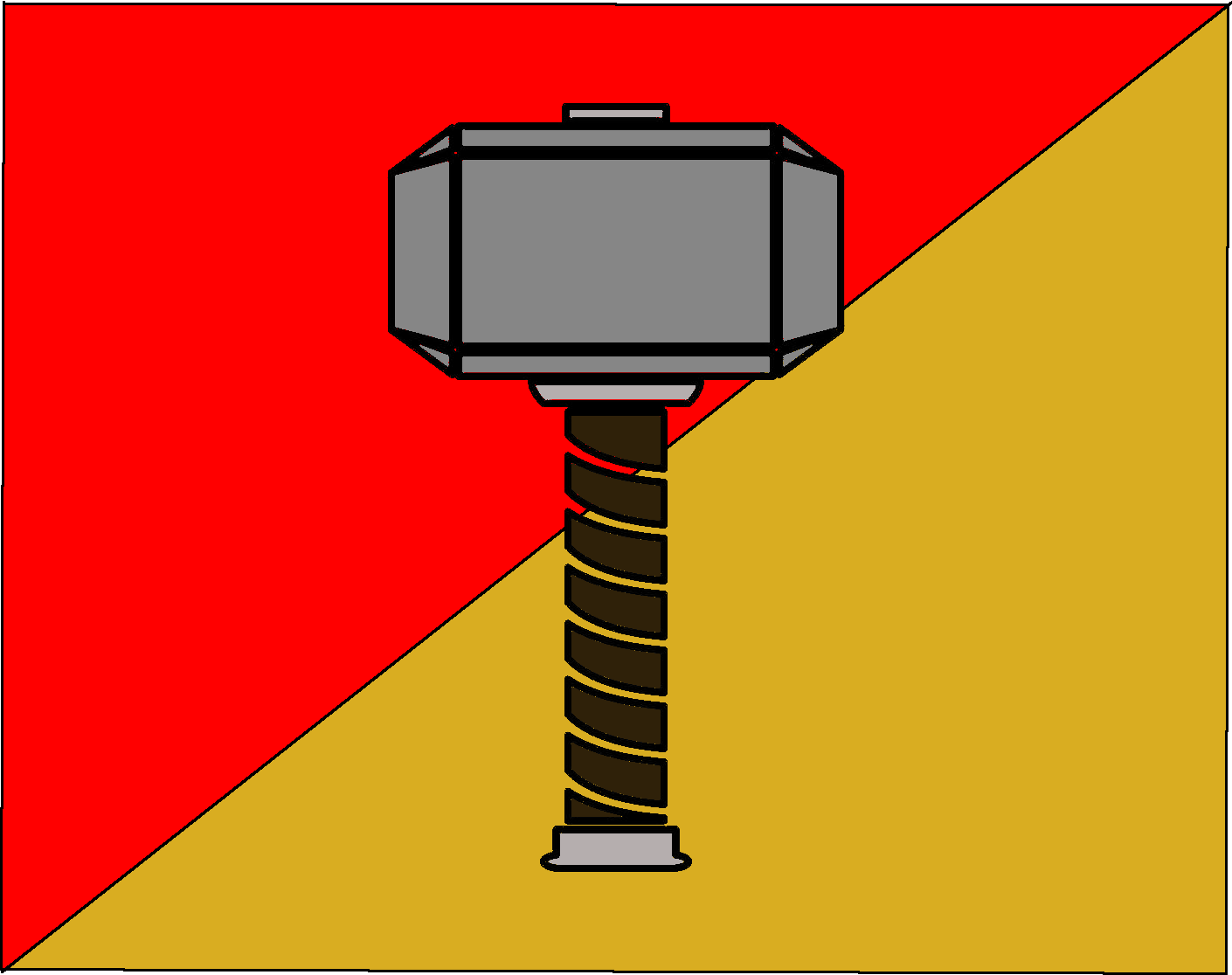
It is said that only three things matter to the proud dwarves of Miden - Ale, Iron, and a good hammer.
Maven Thalmidge, observer and diplomat from the Kingdom of Auphera
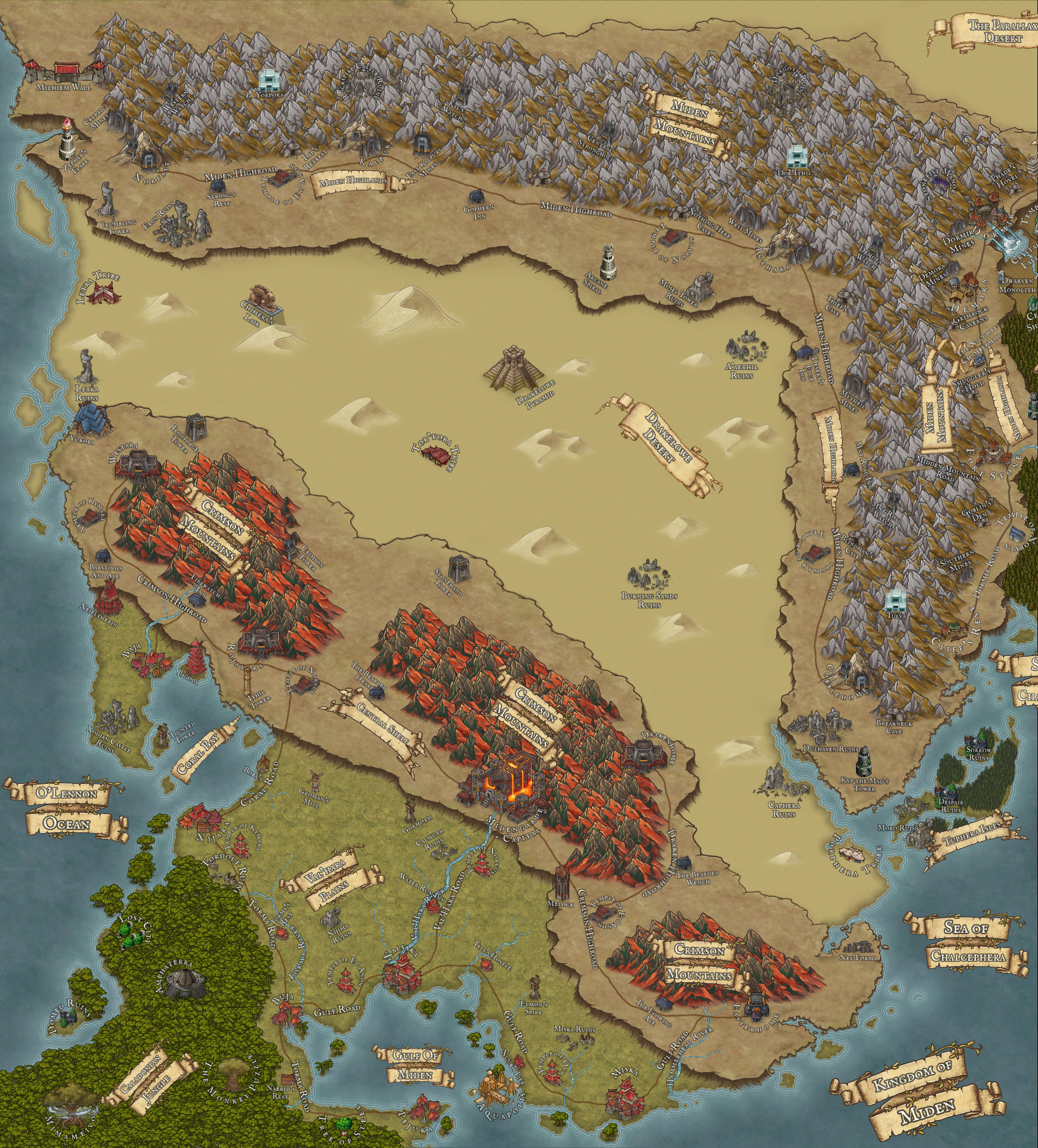
The Kingdom of Miden occupies the Miden Isthmus, connecting the Continent of Chalcephera to the southern Continent of Vega. It is a proud country ruled by dwarves and serves the role of defender and gate keeper to Chalcephera. The Kingdom of Miden is a nation of clan-holds that prides itself on mineral exports, mining, and crafting. From the arid highlands, to the dry Drakelowe and the humid south, the Kingdom of Miden is as varied as it is diverse.
Size
The Kingdom of Miden stretches 1,180 miles north to south and 920 miles west to east, covering 1,085,600 square miles of the Miden Isthmus.
Climate
Miden's climate shifts dramatically from north to south. The Miden Mountains along the northern border hold snow at their higher elevations even as the lowlands stay temperate, and the Miden Highlands south of the range run arid and windswept. At the kingdom's heart, the Drakelowe Desert is hot and bone-dry year-round, broken only by the oases its nomadic tribes rely on to survive. The Crimson Mountains, add their own warmth to the central ranges with active lava flows, though they haven't erupted in recent memory. The southern hold stands in sharp contrast to the rest of the kingdom - humid, fertile, and mild, the conditions that make it Miden's breadbasket.
Government
The Kingdom of Miden is governed by a confederation of Holds, each led by an elected Chief-of-the-Hold. Unlike Auphera, there are no hereditary estates or manors in Miden. Instead, leadership here is earned through election, not passed down by name.
Representatives from each Hold convene in the capital of Midengarde every semester to conduct the kingdom's business. From among the Holds, a High Thane is elected to lead the kingdom as a whole for a term of ten years.
Should the High Thane die or be removed from power before their term ends, an emergency Assembly of the Holds is convened. Rule passes to a council of Chiefs-of-the-Hold while the Assembly debates a successor within one full turning of the seasons. If the vote comes down to a tie, or a margin too close for the Assembly to settle, the matter is decided by Thul Korda (Thuldic for Rule of Hammer), a duel of might between the two leading candidates with the winner taking the title.
The southernmost territory holds a different status within the kingdom. Populated primarily by elves, fae folk, and namarans who fled the zealous Theocracy of Caladonia, this region stands as a semi-autonomous protectorate hold. Rather than a single elected Chief, it is led by a pair of representatives, jointly chosen to speak for the hold as one voice, who, like the northern Holds, report to Midengarde each semester. In exchange for the dwarves' protection, the southern hold pays a tribute of foodstuffs - a fitting arrangement, given its role as Miden's breadbasket.
Culture and Language
Miden is largely a dwarven society with a mix of elf, fae, and namara living in the southern fertile Val'Hara plains. For most of Miden the culture is distinctly dwarven and built around dwarven values, with the other races barely making any cultural waves in the south.
Culture
Miden is a kingdom of many peoples, but its defining character comes from the dwarves who forged it. Theirs is a culture where craftsmanship is character. A well-struck oath and a well-forged blade say more about a person's worth than the family they were born into. Hold-loyalty runs deeper than individual ambition; a dwarf's word given before their Hold-kin is bond enough, sealed as often with a hammer-strike as with ink. Long days in the mountain holds turn into shared evening get-togethers that have made storytelling and ale-hall gathering a central pastime. Sagas of past High Thanes, feats of the forge, and The Caladonian March are told and retold as much as history is written down.
The southern hold stands apart, its elven, fae, and namaran roots shaping a culture built around the land rather than the forge - communal, agrarian, and quieter in its reverence, a legacy of a people who fled a theocracy that demanded loud devotion and chose instead a quieter faith under dwarven protection. Despite their differences however, dwarven cultural values run deep and have sunk into even the southern hold, as they too have learned the value of kept promises and times shared.
Languages
Chalcedonian holds as the language of trade in the Kingdom of Miden as it does all across Chalcephera and perhaps all of Nor'Ova. Despite that, the official state language is the native language of the dwarves - Thuldic. As the state language, it is the language used for all assembly meetings and official kingdom business. It is also the language most in Miden speak, read, and write, with many not knowing any other tongue, even Chalcedonian. When dealing with other countries of course, the diplomats of Miden will use Chalcedonian.
The Southern Hold has the most language diversity of the kingdom, with the elvish "green word" being spoken by both elves and namarans, and runic being the preferred language of the fae folk. They also have kept themselves educated in Chalcedonian, and by law have learned Thuldic, as Thuldic remains the language of Midengarde's law and trade.
Regions
The kingdom is divided into five Holds, each governed by an elected Chief-of-the-Hold — with one notable exception.
Milhiem Hold
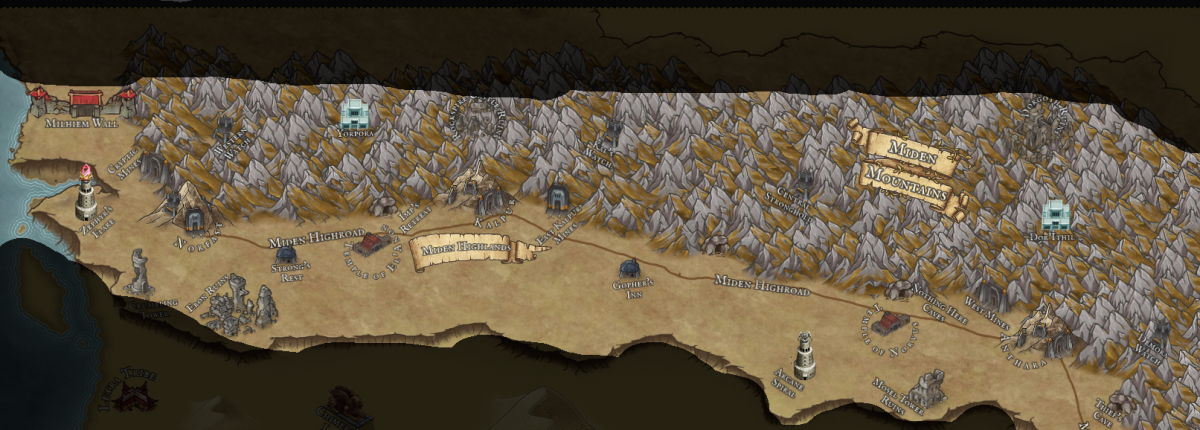
The northernmost Hold, covering the western and central stretch of the Miden Mountains and the Miden Highlands below them, anchored by the Milhiem Wall at the kingdom's edge. Its ruler is Chief Borgna Frostvein. Its principal city is Kalpur. Other settlements include Yorpora, Norpist, Anthara, and Dor'Ithil.
Ironfist Hold
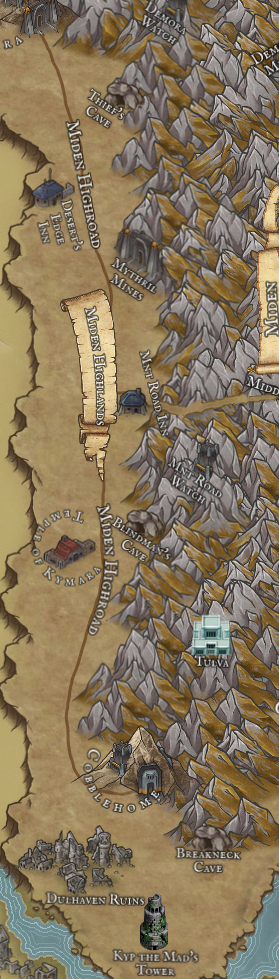
Covers the southern reach of the Miden Mountains and Highlands along the eastern coast. Its ruler is Chief Dagna Stonewright. Its principal city is Cobblehome. Other settlements include Tulva.
Drakelowe Hold
Encompasses the Drakelowe Desert at the kingdom's heart, along with the mountain settlements of Westara and Drakenhome. Its ruler is Chief Skarde Duneshield. Its principal city is Drakenhome, with Westara as its other settlement. The open desert itself is home to three nomadic tribes — the Letra, the Tor'Tora, and the Porphera — who answer to no city and roam its dunes on their own terms.
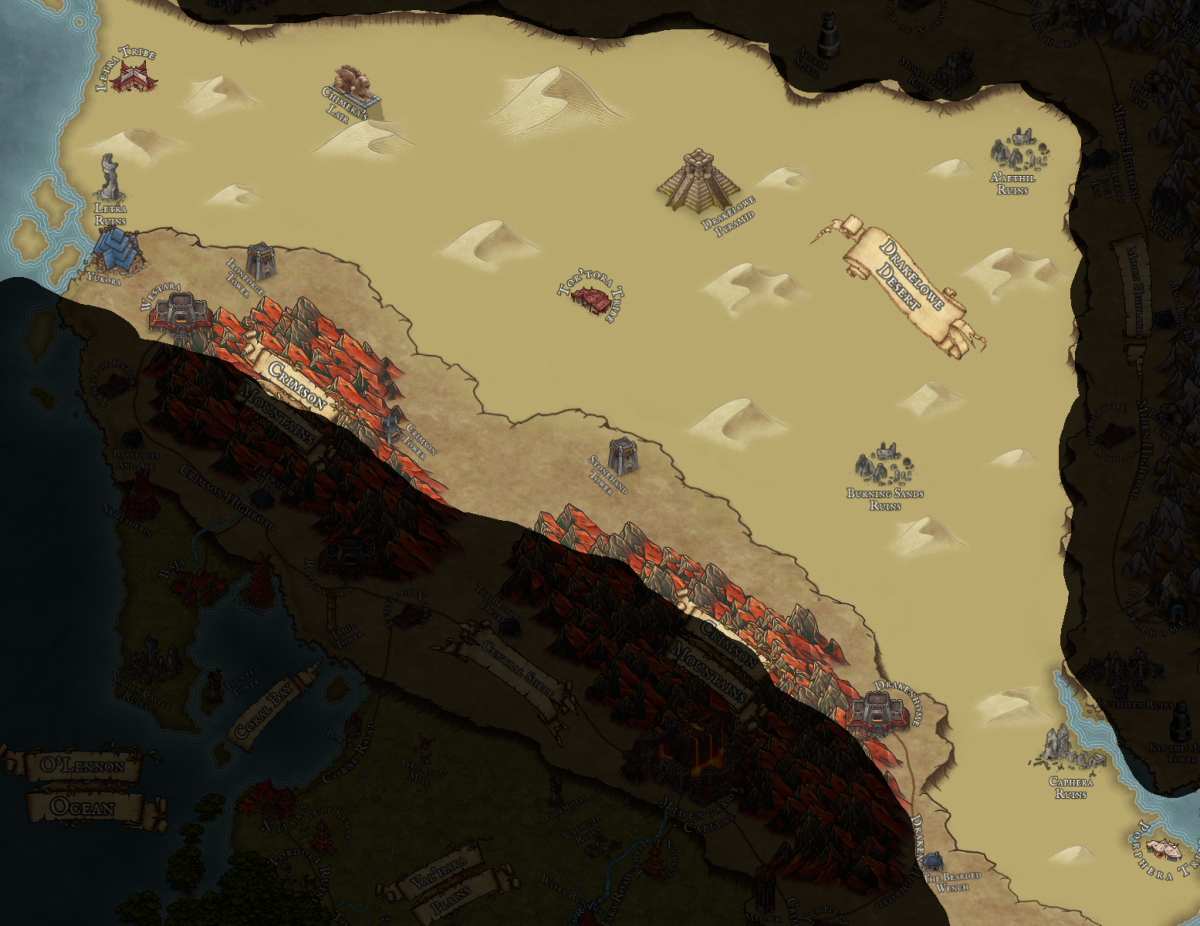
Crimson Hold
Covers the Crimson Mountains at the center of the kingdom, home to Midengarde and its ever-burning forges. Its ruler is High Thane Kaldrun Flamewright, the ruler of all Miden. Its principal city, and the capital of the kingdom, is Midengarde. Other settlements include Rojavra, Melock, and Easterhome.
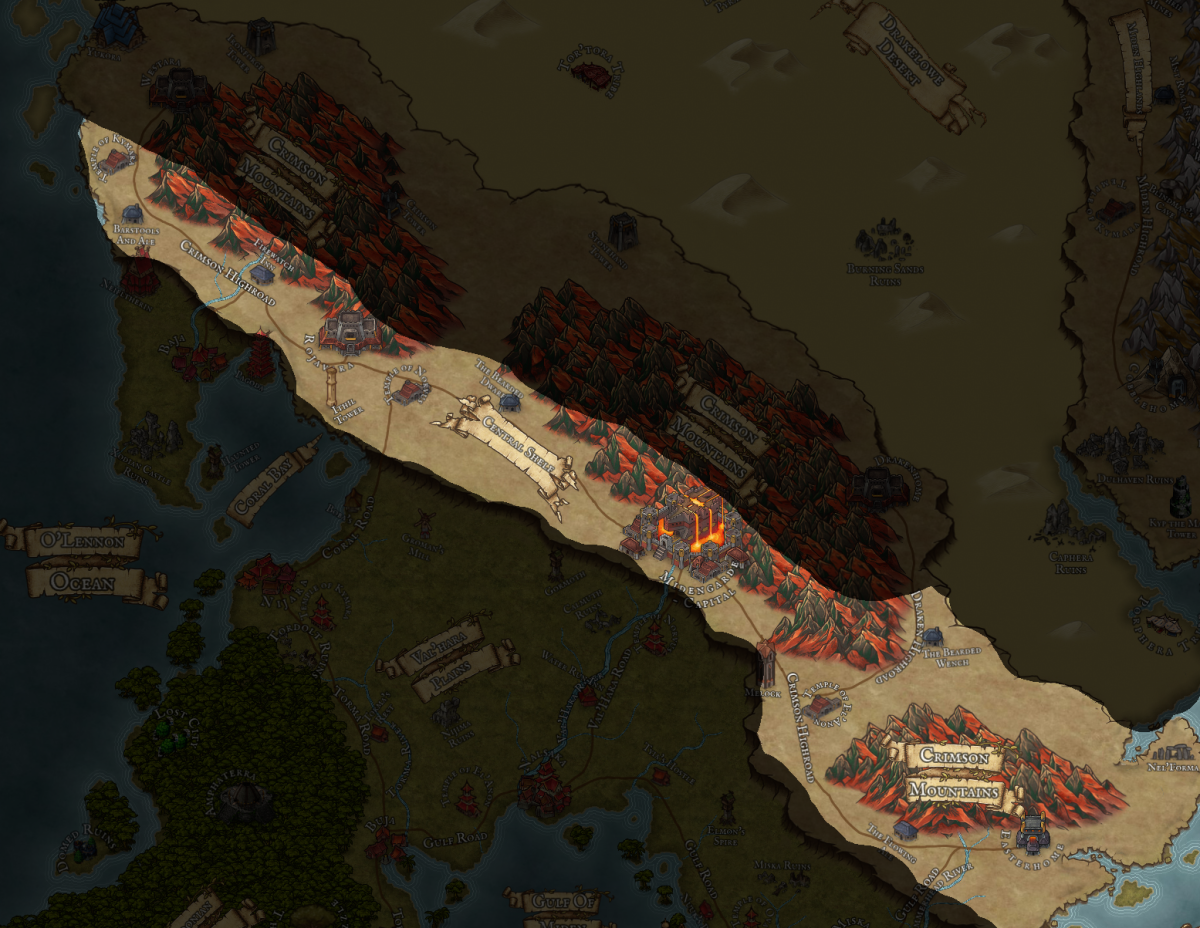
Val'Hara Hold
The fertile southern plains, and the kingdom's breadbasket. A semi-autonomous protectorate unlike the other four, Val'Hara is governed jointly by two co-chosen representatives rather than a single Chief — Elder Thessaly Windrue for the elven community and Fenrick "Fenny" Briarwhistle for the fae folk. The namarans who also call the hold home traditionally abstain from politics. Its principal city is Naksaka. Other settlements include Nijara, Aquapolis, and Miska.
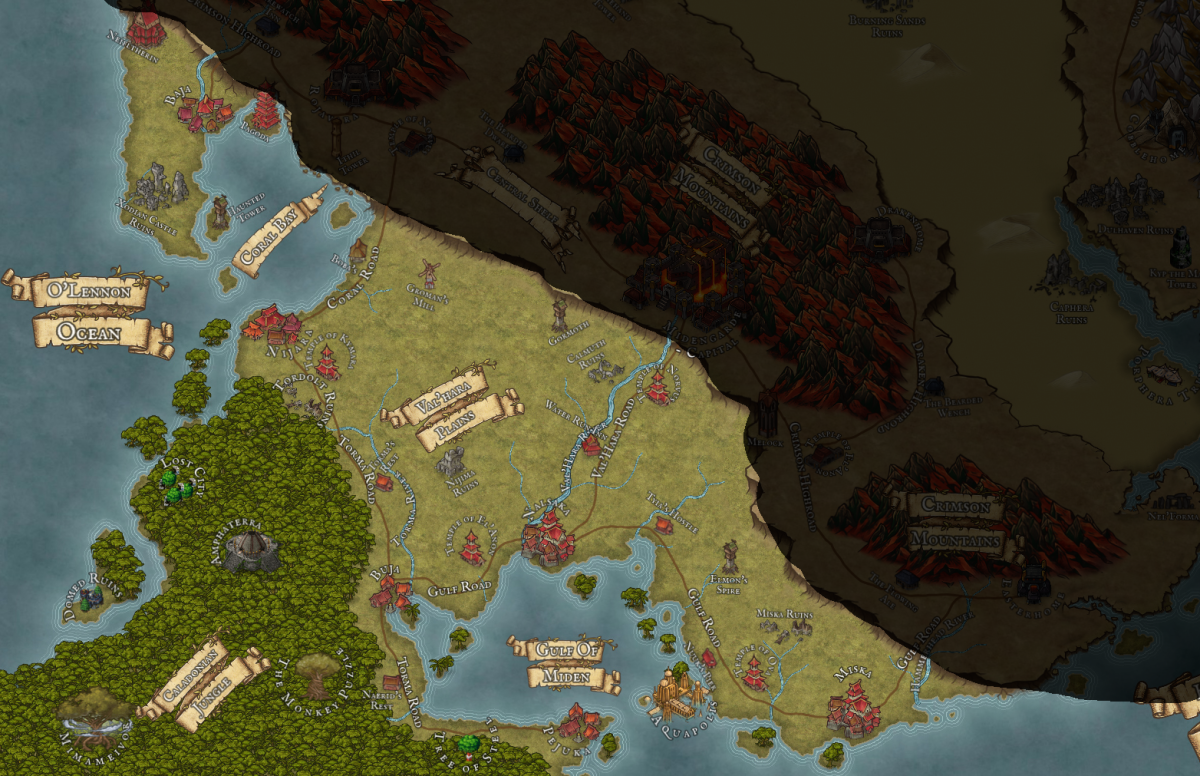
Religion
There is no state religion in the Kingdom of Miden. The holds prohibit any ritual that causes harm to another person or to the land, but they do not outlaw belief itself. Nor may anyone compel another to worship as they do; in Miden, faith is a matter between a dwarf and the gods, not between a dwarf and their neighbor. Most dwarves revere El Anon, whom they call the Great Father, alongside Norvus and, less commonly, Kymara. Faith among the dwarves is practical more than doctrinal. A well-made tool, a kept oath, and a life of honest labor are regarded as the truest forms of devotion. Temples exist, but the forge and the hold-hall often serve as the real centers of reverence.
Sacrifice and craftsmanship hold special weight. The greatest honor a dwarf can offer the gods is work done so well that it outlasts the maker. Many holds keep a "Thane's Anvil" or similar shrine where masterworks are dedicated before being put to use.
In Val'Hara, the picture is broader. Alongside temples to El Anon, Norvus, and Kymara stands a temple to Ova, the only one in the kingdom. It was sanctioned as part of the protectorate itself, a right granted to the refugees when Val'Hara was founded, and the holds have honored that promise ever since. Other faiths are practiced more openly in the south, though only those four are permitted public temples. The quieter, land-centered spirituality of the elves, fae, and namarans has influenced the hold, but even here the dwarven emphasis on kept promises and lasting work has taken root.
A Brief History
The Forge of the Empire
In the late First Era, the lands now called Miden belonged to the Empire of Nor'Ova, divided into three imperial states: Miden and Drakelowe in the north, and in the south Torma, named for the river that runs through its fertile plains. Miden was the industrial heart of the Empire. Its mines and forges fed the war machine, and so valuable was dwarven labor that the dwarves were never drafted into the Empire's armies. They were needed at the anvil, not on the battlefield.
The Long Dark
When the Great Magic War came to its ruinous end, the dwarves did as they had always done and retreated into their mountain holds. Unlike the peoples of the surface, they were well accustomed to life beneath the stone, and when others began to emerge into the light, the dwarves felt little need to follow. Over the long centuries underground, the holds of the two mountain ranges grew apart. The holds of the Crimson Mountains united as one nation, and the holds of the Miden Mountains as another. Each called itself Miden, and neither knew the other did the same.
The First Thul Korda
The trouble began not when the dwarves emerged, but when the two Midens finally met. Each had its own High Thane, and each Thane believed himself the rightful ruler of all Miden. Rather than spill the blood of kin in open war, the two Thanes met in single combat, the first Thul Korda. It was a far fiercer contest than the formal duels that bear its name today. Redrian Stormfist, High Thane of the Crimson holds, emerged the victor, but the battle was so close that neither side could claim a clear verdict, and the holds feared a second, bloodier reckoning. And so a compromise was struck. The throne would sit in the Crimson Mountains, at Midengarde, but the kingdom would carry the name the mountain holds had always claimed. And the office of High Thane would never again pass from father to son. It would go to whoever the holds elected, and Thul Korda would be reserved for when the vote could not decide. The kingdom of Miden was born of that bargain, and it has kept it ever since.
The Caladonian March
Some 150 years ago, the Theocracy of Caladonia, coveting the riches of the Miden and Crystal Mountains, marched an army north across the Isthmus. Warning came before the army did. Waves of refugees fleeing the Theocracy carried word to the dwarves, and many of them did more than warn. They raised defenses in the Caladonian Jungle and stood against the army that pursued them, and many died there for a homeland not yet their own. Half of the Theocracy's army never escaped the jungle. Of those who did, half were broken at the Crimson Mountains, and the remainder perished in the sands of the Drakelowe. Caladonia has not tried its luck since.
The dwarves do not forget a debt. The refugees who bled for Miden were given the fertile plains of old Torma as their own, and Val'Hara became a protected hold of the kingdom. Its people pay their tribute in grain, but the dwarves will tell you plainly that the true price was paid in the jungle long ago.
Miden Today
High Thane Kaldrun Flamewright is in the fourth year of his term. Miden has long been content to keep to its own affairs, but it keeps a close watch on every border, and lately it has had reason to. To the north, Chaladonia has sealed itself off. To the south, the Theocracy of Caladonia has never stopped coveting the mountains. And to the west, Auphera, Miden's longtime ally, has changed. The dwarves still trade with Auphera, and Auphera has shown no aggression toward them, but its sudden embrace of the Church of Mana and its seizure of the cathedral of Kymara alarmed the holds deeply. Miden does not meddle in matters that are not its own. But it is strengthening its defenses, and the holds speak quietly of trouble to come.
Peoples of Miden
Dwarves
Dwarves make up the overwhelming majority of Miden, and the kingdom is theirs in every sense: its laws, its language, its halls, and its sagas. Dwarven regard is earned, not given. A dwarf judges others by their work and their word, and a stranger of any race who keeps a promise and does honest labor will find Miden more welcoming than its stern reputation suggests. One who breaks a promise will find the opposite, and the holds have long memories.
Elves, Fae Folk, and Namarans
The peoples of Val'Hara hold a place no other outsiders can claim. To the dwarves, they are not refugees who were taken in, but kin-by-debt, the ones who bled in the jungle so Miden would not have to bleed at home. Dwarven sagas of the Caladonian March name elven and fae heroes alongside their own, and to speak ill of Val'Hara's dead before a dwarf is to invite a fight. That respect has its limits, though. Few southerners hold office outside their own hold, and many dwarves still think of Val'Hara's quieter ways as soft. Among the southerners themselves, some of the eldest elves still remember the March firsthand, and the younger generations, born under dwarven protection, have grown up thinking of themselves as Mideners.
The Drakelowe Nomads
The Letra, Tor'Tora, and Porphera are human tribes who live apart from hold and city alike. They acknowledge Drakelowe Hold, and the Hold acknowledges them, and both are content to leave it at that. Trade passes between them at the desert's edge, and Drakelowe's guards know better than to chase a nomad into the deep sands. Neither side trusts the other entirely, but neither has given the other reason to stop.
Goblins
Goblins are few in Miden and unwelcome in most of it. Dwarven memory is long, and nearly every mining hold has a saga of goblins who came offering to share the work, only for the tunnels to collapse, fill with gas, or catch fire. Most goblins in Miden live in mines the dwarves have abandoned, and a dwarf who finds one in a working mine is unlikely to ask questions first.
Neighbors and Outsiders
Dwarves living in the Aupheran highlands are regarded as cousins who chose the wrong side of the border, welcome to trade and to drink, but no longer quite of Miden. Aupherans themselves were long treated as allies, and travelers from Auphera are still received politely, though under closer watch than they once were. Caladonians are another matter. Any who come from the Theocracy are watched closely, and those who come preaching are turned back at the border.
The Sleepers and the Awakened
Miden has not escaped the Dark Paralysis. Its sleepers are fewer than Auphera's, but they are still numerous enough that every hold must set aside care and resources for them. Much of that care falls to Val'Hara, whose healers and caretakers have taken on the work the dwarves are less suited to. Many sleepers from the northern holds are carried south to be tended in Val'Hara's halls, and it has become one more thread binding the southern hold to the rest of the kingdom.
Those who wake fare better in Miden than in most places. With no state faith to answer to, the Awakened face no religious condemnation, only curiosity. The dwarves are of two minds about them: some hold that an Awakening is a blessing, a soul returned by the gods, while others see it as an ill omen, a sign of something stirring that should have stayed asleep. Few dwarves agree on which, and many argue it over ale. Whatever they believe, the dwarves see that the Awakened are cared for, and see them back to work and back into the life of their hold as quickly as they can manage. To the dwarven mind, idleness is a worse affliction than any sleep.