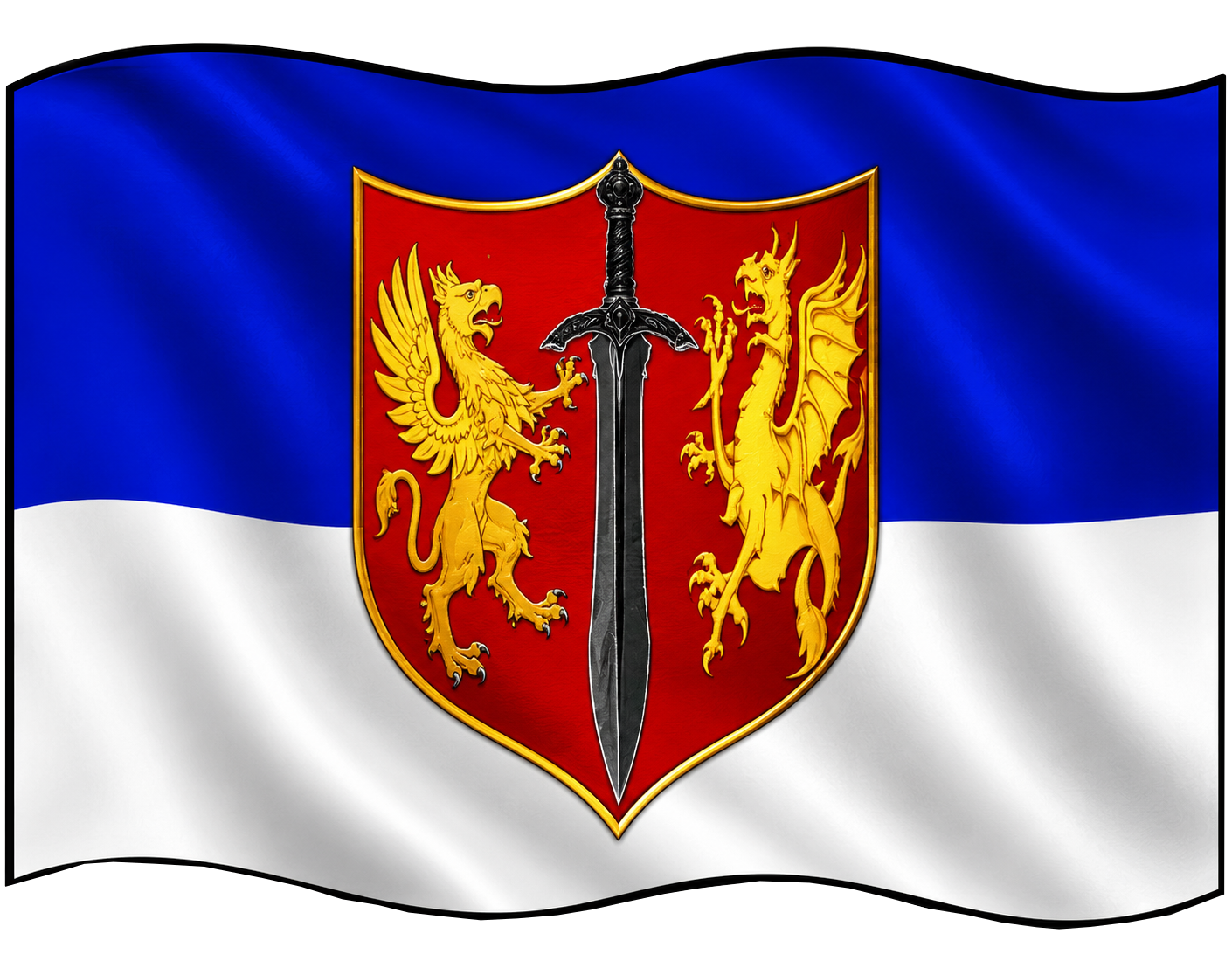
Auphera, where the study of magic became a religion and echoes of the past haunt the living.
Gavin Klout, historian
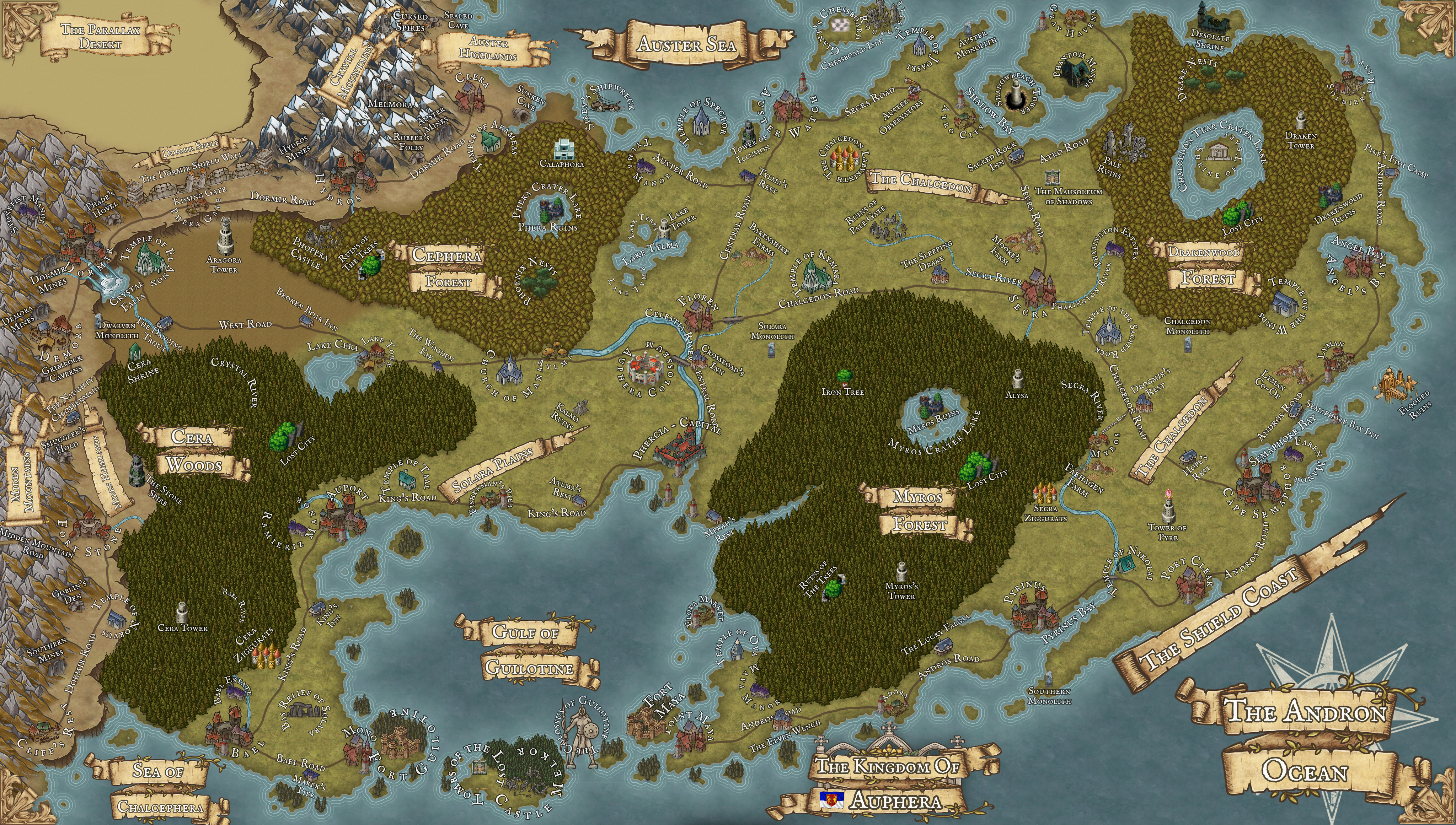
The Kingdom of Auphera occupies the southwestern reaches of the Continent of Chalcephera. It is the largest and most politically prominent kingdom on the continent. It is a nation of warm coastlines, ancient history, and a deeply complicated relationship with magic that has shaped everything from its government to its state religion.
Size
The Kingdom of Auphera stretches 1,076 miles north to south and 1,716 miles east to west, covering 1,846,416 square miles of the Continent of Chalcephera.
Climate
Auphera enjoys a warm temperate climate across most of its territory. The southernmost regions along the Sea of Miden and the Shield Coast have a more subtropical character. Snow is very rare throughout the kingdom. The highlands and the Miden Shelf run more arid.
Government
The Kingdom of Auphera is an absolute monarchy. The King holds all power. A House of Lords convenes to advise the king, but he is under no obligation to follow their counsel.
The current king is King Cadimus Mercleis X, who has reigned for 30 years. His father, Cadimus IX, ruled for only a year before dying under unknown circumstances, after which his brother was quickly sworn in as Cadimus X. Their father, Cadimus VIII, ruled for 180 years.
The kingdom is divided into four grand parishes, each ruled by a Grand Duke. Each parish is further divided into dukedoms led by individual dukes, who answer to their Grand Duke and provide a portion of their supplies and shillings upward through the hierarchy to the King. Dukes appoint judges within their dukedoms. Each town provides its own civilian security, and all men must serve five years in the dukedom guard - typically the first five years of adulthood - in exchange for the right of citizenship.
Culture and Language
Auphera is a kingdom of many races, each with their own languages and cultures. However, there is a defining culture and language that established Auphera as one body, one nation.
Culture
The prominent culture of Auphera centers on experimentation and discovery, strong ties to both family and community, and a deep love of celebrations and festivals. Aupherans are a community-first people. Most will willingly sacrifice for the greater good of their city, town, or village, and individual wealth or personal fame are generally viewed as concerns of the nobility rather than ideals for common folk. They will give freely to help those within their own community. Strangers, however, are another matter. Outside the larger cities, outsiders are often met with distrust and suspicion simply because they are unknown.
Languages
The languages of Auphera are as varied as its peoples. Chalcedonian, also known as “the common tongue,” is the principal language and the official language of the state. All government documentation must be written in Chalcedonian. It originally developed in the Chalcedon plains - long regarded as the cradle of society - and remains a highly descriptive language that continues to evolve.
After Chalcedonian, the most commonly heard languages are Elven, Dwarven, and Xodian.
Regions
The kingdom is divided into four grand parishes, each encompassing several dukedoms.
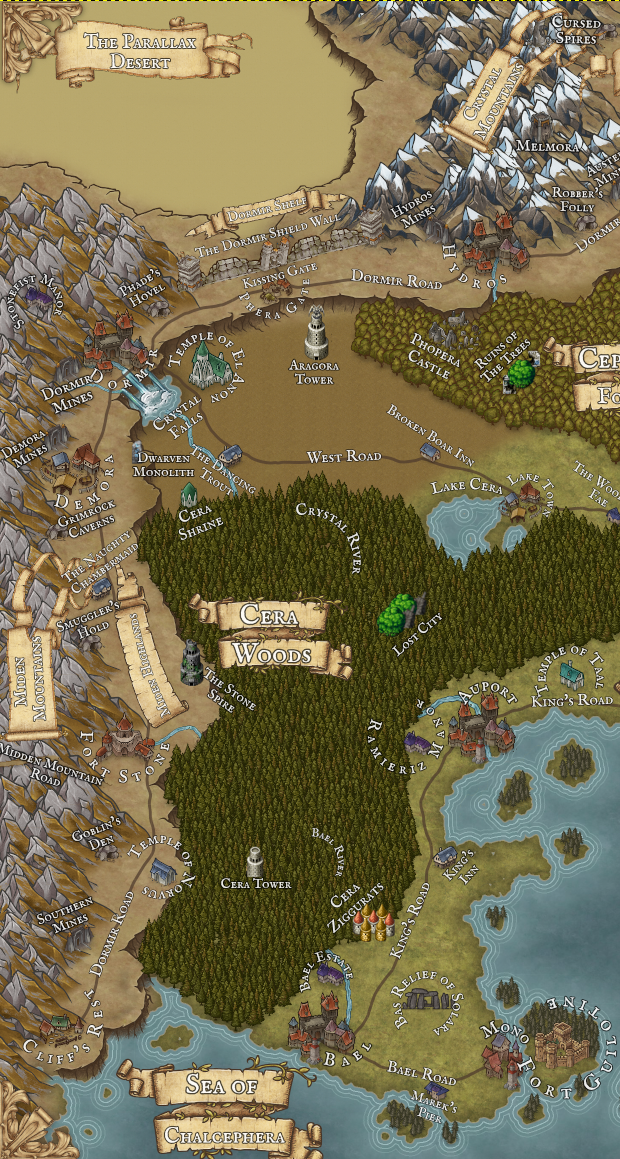
The Western Parish
The Western Parish lies between the Miden Mountains and the Crystal River. Its ruler is Grand Duke Aereal Ramieriz. The parish contains three dukedoms:
- Domora Dukedom: The northernmost dukedom of the Western Parish, covering the Dormir Shelf from Clera to the Crystal River. Its principal city is Dormir, ruled by Duke Gaus Stonefist. Other settlements include Phera Gate, Hydros, and Clera.
- Cera Dukedom: Bordered by the Crystal River (running through Cera Woods) to the south and reaching the western edge of Fisherman’s Pier to the west. The eastern edge of Cephera Forest forms the rest of the eastern border up to the Auster Sea in the north. The Miden Mountains mark the western border, extending no farther south into the Miden Highlands than Grimrock Caverns. Its principal city is Auport, ruled by Duke Gavin Strous. Other settlements include Demora, Lake Town, and Alyma.
- Bael Dukedom: Lies between the Sea of Chalcephera to the south and the Crystal River to the north, with the Gulf of Guillotine to the east and the Miden Mountains as its western border. Its principal city is Bael, ruled by Duke Ian Bael. Other settlements include Mono, Fort Stone, and Cliff’s Rest.
The Central Parish
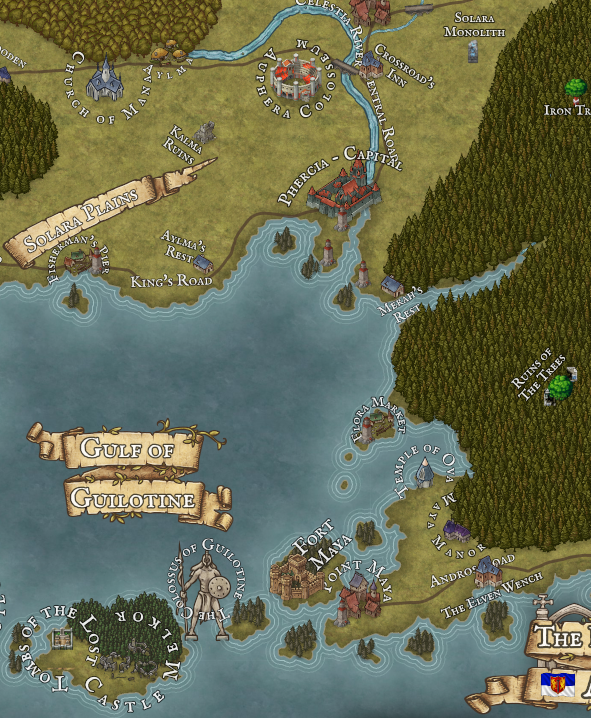
The Central Parish is home to the capital of the kingdom, Phercia, as well as the College of Arcana and the Auphera Colosseum. The King holds direct control over the parish. It lies between the Crystal River to the northwest and the Chalcedon Road to the northeast. A straight line running just west of Fisherman’s Pier and intersecting the Celestia River marks the western border; the western edge of Myros Forest marks the eastern border. The parish contains two regions:
- Capital Region (The King’s Land): This region comprises the north shore of the Gulf of Guillotine, from Fisherman’s Pier in the west to the Celestia River in the north, and the western edge of Myros Forest in the east. The southern reaches include Merah’s Rest and Inlet. It is not part of any dukedom. This region contains the capital city of Phercia, the Auphera Colosseum (with its small associated settlement), and the village of Fisherman’s Pier.
- Maya Dukedom: Bordered to the west by the Gulf of Guillotine, to the north by Merah’s Inlet, and to the east by the western edge of Myros Forest (with a straight line running just east of The Elven Wench Inn). Maya Dukedom is perhaps the smallest dukedom in the kingdom. Its principal city is Point Maya; its only other settlement is Flora Market, a village reachable only by boat. Duchess Isabella Vael governs the dukedom in the stead of her recently deceased husband, Duke Francis Vael, and resides at Maya Manor.
The Chalcedon Parish
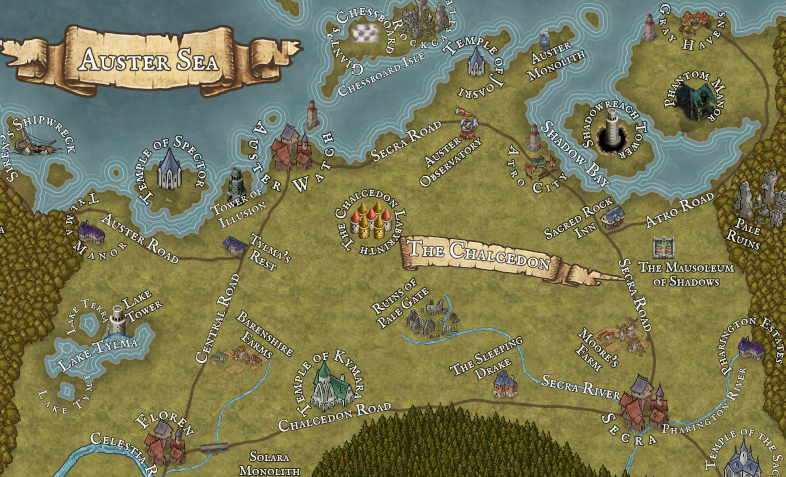
The Chalcedon Parish lies east of the Cephera Forest and south of the Auster Sea. The eastern border follows the Pharington River until it becomes the Secra River. The southern border follows Chalcedon Road until it meets the northern edge of Myros Forest, then follows the northern edge of the forest to the Secra River. Its ruler is Grand Duke Kelvin Pharington, who is reported to have descended into madness following the death of his wife. The parish contains two dukedoms:
- Tylma Dukedom: A small dukedom east of the Cephera Forest and south of the Auster Sea. The eastern border is the Central Road, terminating just west of Auster Watch. The southern border follows the Celestia River. Its principal city is Floren; however, the duke, Duke Varcus Armondi, resides at Tylma Manor in the northwest of the dukedom. There are no other settlements, though the dukedom is home to the Barenshire Farms.
- Chalcedon Dukedom: Encompasses the majority of The Chalcedon, south of the Auster Sea and east of the Pharington River. The southern border matches the southern border of the parish. Its principal city is Secra, ruled by Duke Nathaniel Morris. Other settlements include Auster Watch, Atro City, and Gray Havens.
The Eastern Parish
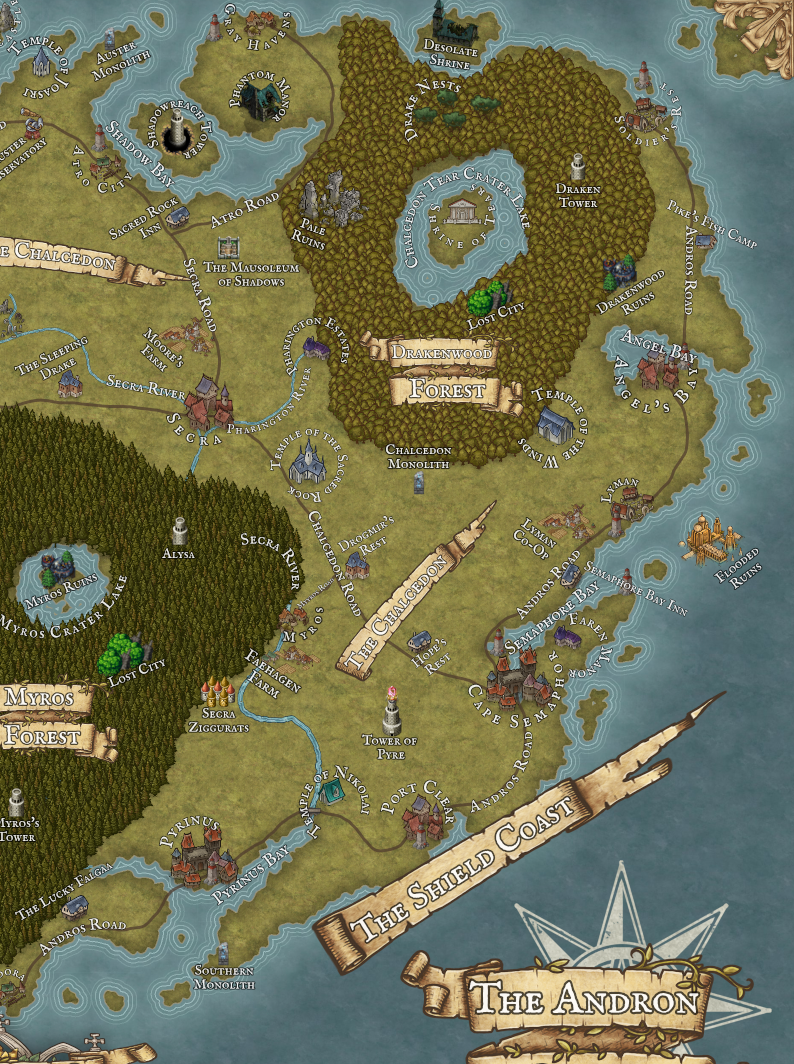
The Eastern Parish lies east of the Pharington and Secra Rivers. The Andron Ocean forms its eastern and southern borders, and the Auster Sea forms its northern border. The parish contains the entirety of Myros Forest and Drakenwood Forest, as well as the remainder of The Chalcedon. It is the largest parish in the kingdom. Its ruler is Grand Duke Gavin McPherson. The parish contains three dukedoms:
- Drake Dukedom: A small dukedom containing Drakenwood Forest and the lands east of the forest to the Andron Ocean, with the Auster Sea to the north. The southern border is a straight line from the southern edge of Drakenwood Forest to the ocean. Its principal city is Angel’s Bay, ruled by Duke Marcus Pherin. Other settlements include Soldier’s Rest.
- Semaphore Dukedom: Lies in the middle of the parish, from the Pharington and Secra Rivers in the west to the Andron Ocean in the east and south, with Drake Dukedom to the north. The dukedom is run by Duke Micha Moore. The principal city is Cape Semaphore; other settlements include Lyman and the Lyman Co-Op, Myros, and Point Clear.
- Pyrinus Dukedom: The southernmost dukedom of the parish. Despite containing all of Myros Forest, it is regarded as a small dukedom. The Secra River marks its eastern border and the western edge of Myros Forest its western border. Myros Forest forms the northern border, with the Andron Ocean and Sea of Chalcephera to the south. Led by Duke Stephan Covington, the principal city is Pyrinus; the only other settlement is Adora.
Religion
The state religion of Auphera is the Church of Mana, which holds that magic is a living and sentient force worthy of reverence. It grew out of the scholarly community at the College of Arcana, where certain researchers became convinced that what they studied was not merely a tool but a divine presence in its own right. The Church teaches that the elemental forces themselves are the true objects of devotion, and that magic, as their expression, is sacred.
Other beliefs are permitted throughout the kingdom, and temples of various faiths can be found in most major cities. The worship of Zodo, however - along with any faith judged to be similarly aligned - has been declared illegal by royal decree. Penalties range from imprisonment to execution upon conviction, though enforcement varies considerably from dukedom to dukedom. It is widely rumored that certain dukes quietly tolerate forbidden practices within their territories.
A Brief History
Before Auphera
Long before Auphera existed, its lands lay within the Empire of Nor’Ova under Emperor Killian Xerxes. It was a fateful place to be. To the north lay the Kingdom of Angeria, Taal’s ally in the war against the Empire, and when the Great Magic War came, the region stood near its front lines. Cities such as Phercia and Pyrinus - home to the famed University of Pyrinus - were lost along with nearly everything else of the First Era.
The Long Dark
The survivors fled underground, and there they and their descendants remained for roughly five hundred years. Around 490 of the Second Era they began to return to the surface. They rebuilt Phercia and Pyrinus on the bones of the old First Era cities, though without the knowledge that had built them, and founded new settlements such as Floren and Auport. For generations these remained independent cities, bound together by little more than shared hardship.
The Founding
Some six to seven centuries ago, the cities of Phercia, Floren, and Auport united as a single state under Cadimus Mercleis, who became its first king. He named his kingdom Auphera, which he declared meant “All Pherians,” after the people of Phercia. Scholars of Xodian have long noted that it closely resembles the Xodian word Alfera, which means “all fear.” The crown has never acknowledged the resemblance.1
Among the very first laws of the new realm was the ban on the worship of Zodo. Cadimus had heard the tales that Zodo was the cause of the Great Magic War, and he took no chances. The ban has never been lifted.
Cadimus was a devout follower of Arameas. The kingdom’s mandatory guard service has its roots in his faith, and he named one of his five sons Armeas in reverence of the god of law. Armeas became the first High Judge of the Temple of Arameas in Auphera while still in his thirties and was said to possess powerful prophetic gifts. His prophecies - darker and more concerned with the end of all things than any before them - are preserved among the later Apocalypse Papers.
Growth of the Kingdom
ver the following centuries, more cities and regions joined the kingdom, by choice or otherwise. Auphera reached its present size under Cadimus IV. By 836 of the Second Era, Cadimus VI sat on the throne, and it was to him that the chronicler Nathaniel Aeryn Gourimondi addressed his account of the great Awakening from the Dark Paralysis. Cadimus VIII would go on to rule for 180 years, the longest reign in the kingdom’s history. Earlier kings of the house openly claimed kinship with Taal Mercleis, and for centuries the shared name lent the crown a measure of borrowed divinity. Cadimus X has never made the claim. Royal histories published during his reign omit it entirely.2
The Mercleis kings have always been known for remarkably long lives and reigns, and for a strong family resemblance. Court historians have occasionally remarked that portraits of successive kings are difficult to tell apart. The crown attributes this to good blood.
Faith and the Crown
For nearly all of its history, Auphera had no state religion. Despite its founder’s devotion, the Temple of Arameas would not accept the role, since its doctrine forbids compelling belief. Many faiths flourished freely, and the Church of Sol Anon raised one of its greatest cathedrals, the Grand Cathedral of Kymara, in Phercia.
That changed within living memory. Thirty years ago, around the time Cadimus X took the throne, roughly half the scholars of the College of Arcana proclaimed that magic was the one true religion, and that the elemental symbols were not symbols at all but the deities of magic. The Church of Mana spread rapidly. Twenty-five years ago, Cadimus X converted and declared it the state religion. The Grand Cathedral of Kymara was taken and converted into the Church of Mana’s principal church. The Church of Sol Anon protested publicly and demanded recompense, but with its central church in the Kingdom of Chaladonia facing troubles of its own, it has so far done little else.
- 1. Whether Cadimus intended the double meaning, misunderstood the word, or simply liked the sound of it is a question that has occupied Aupheran scholars for centuries. Those who raise it at court tend not to raise it twice.
- 2. Why the current king would abandon so valuable a claim is a subject of quiet speculation. Some say the Church of Mana, which reveres magic rather than gods, made it an embarrassment. Others suggest the king simply has reasons to be less interested in his family history than his predecessors were.
The Realm Today
A Hurried Succession
Thirty-one years ago, King Cadimus IX died under circumstances that have never been explained, a single year into his reign. His brother was crowned Cadimus X with a speed that some found reassuring and others found suspicious. The crown’s official account describes a sudden illness. In a family famed for its long lives, few found that explanation convincing, though fewer still have said so aloud.
The Rise of the Church of Mana
No change in living memory has reshaped Auphera like the rise of the Church of Mana. Within five years of its founding at the College of Arcana, it became the state religion. Its faithful see a kingdom finally honoring the true divinity behind all things. Followers of the older faiths see a church that seized the Grand Cathedral of Kymara and now holds the crown’s ear in nearly every matter. The College of Arcana itself remains divided: roughly half its scholars proclaimed the new faith, and the other half did not. The two halves still share the same halls.
Troubled Houses
The kingdom’s nobility has suffered its share of misfortune and controversy. Early in his reign, Cadimus X carved the Chalcedon Parish out of the Central Parish and granted it to his friend and colleague Kelvin Pharington, raising him to Grand Duke. Pharington is now reported to have descended into madness following the death of his wife, and who truly governs the parish in his stead remains a matter of speculation.
In the Maya Dukedom, Duchess Isabella Vael governs in place of her recently deceased husband, Duke Francis Vael. In a kingdom where a woman’s rights flow from the men of her household, a duchess ruling in her own name is not something the nobility has taken lightly — or well.
The Silence of Atro City
Most recently, word spread from the Chalcedon Dukedom that the people of Atro City had been found mindless: alive, but empty, unable to act of their own will. The incident was grave enough that the Templars of Mercy, followers of Taal stationed at Secra, rode out to investigate. What caused it has not been publicly confirmed.
The Awakened
Centuries after the great Awakening of 836, those lost to the Dark Paralysis still occasionally wake. They come in a trickle now rather than a flood, but each returns from a lifetime in a world where Zodo was the only god into a kingdom where his worship is a crime.
Faith in the Shadows
The ban on Zodo worship remains in force, though enforcement varies considerably from dukedom to dukedom. It is widely rumored that certain dukes quietly tolerate forbidden faiths within their lands.
Peoples of Auphera
Auphera is a kingdom of many races, though not all of them share in it equally. Humans make up the majority - roughly fifty-eight percent - and Aupheran culture, law, and language are built largely around them. The rest of the kingdom's people find their place within that culture with varying degrees of welcome.
Elves
Elves are the kingdom's largest minority, and they can be found nearly everywhere, though which elves depends greatly on where one looks. The most common by far are the xeno elves, who live in especially large numbers in Phercia.
Angerians
Angerians are most often found along the kingdom's northern and eastern coasts. For most of Auphera's history, they have been revered and respected as angelic beings, and many Aupherans still treat an Angerian's presence as something close to a blessing. In recent years, however, they have increasingly come under fire from the Church of Mana, which holds that too many Angerians have abused the station their appearance grants them. The Church points, not without some cause, to those Angerians of a more exploitative mind. Whether that is the true reason for the Church's hostility, or merely a convenient one, is far less certain.
Dwarves
Dwarves live mostly in the Miden Highlands and the Auster Highlands, close to their kin in the Kingdom of Miden. They tend to keep to their own holds and their own faiths, and Aupherans generally regard them as hard-working, reliable, and best left to themselves.
Dweller Elves
The Dweller Elves of Auphera are found mostly around the Crystal Mountains. They never speak their goddess's name aloud. They call her only the Life and the Mother. Some Aupherans take this as the mark of especially devout followers of Kymara. Others suspect they are pretending for some purpose of their own, and do not trust them. If the true object of their faith were ever proven, it would be illegal. Dwellers seem notably more at ease in the Tylma Dukedom than anywhere else in the kingdom, and the reasons for this are the subject of rumors that few repeat near Tylma Manor.
Xodians
Xodians keep to the larger cities, where it is easier to go unnoticed, and most do everything they can to pass as human. In a kingdom that outlaws the god so many of their kind are believed to revere, those who are found out are often run out - especially in smaller towns and rural areas.
Smaller Peoples
Goblins, fae, and tieflings make up the smallest portion of Auphera's population. The kingdom's Namarans are another matter: no one knows how many there are, since they rarely leave the forests.
The Awakened
The Awakened are not a race, but they are a people apart. They are pitied for what they do not know, and feared for what they remember. They are always watched. Those who adapt quickly can build new lives. Not all of them live long.
Citizenship and Its Limits
Every man in Auphera, of any race, must serve five years in his dukedom's guard - typically the first five years of adulthood - in exchange for the right of citizenship. Women are not full citizens. They are granted certain protections under the law, but their rights flow from the men of their households.