
He who goes through life without learning is a life wasted. Knowledge is power, without it mankind is nothing more than just another animal…
In this section we will discuss how to level up your character and how to acquire new skills and abilities for your character.
Back to top1) Leveling Up
The Node Chart
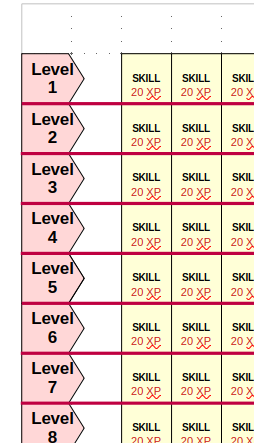
Leveling up your character is done by gaining experience (XP) and spending that XP on the node chart.
1.1) How To Level Up Your Character
You level up your character by gaining experience points (XP), like in most other RPG's. However, Legends in Nor'Ova is unique in how you use those gained XP. You spend them on a node chart.
1.1.1) Node Charts
Each profession has a node chart. You can only access the node chart that belongs to your character's profession. If you are using dual professions, you can access the node charts for both professions. The node chart is split up into 21 rows, each row being a level. Within each level there is a selection of different "nodes" that you can spend XP on to give to your character. The different node types are skill, ability, spell, trait, stat, and vitality.
 | Skill Nodes: These are nodes you purchase to acquire skills for your character. Skills that are in your character's profession costs 1 skill node. Skills that are outside of your character's profession cost 2 skill nodes. |
 | Ability Nodes: These are nodes that you purchase to acquire abilities for your character. You can only get abilities that are within your character's profession. If you are using dual professions, you can get abilities from both. |
 | Spell Nodes: These are nodes that you can purchase to acquire spells for your character. For more information about spells please see the page Magic. |
 | Trait Nodes: These are nodes you can purchase to increase your character's traits. If the node simply says TRAIT P. like in the picture here, it can be for any traits. However If it says something like STR TRAIT P. then it can only be traits for that stat, strength in this example. |
 | Stat Nodes: These are nodes that you can purchase to increase your character's stats. These are for the main stats, not the traits. Do note however that increasing stats can affect their traits. If it is simply STAT P. like in the picture here then it can be for any stat. However if it says something like STR STAT P. then it can only be for that stat, strength in this example. |
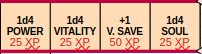 | Vitality Nodes: These are nodes that you can purchase to increase your vitality stats. Each node says what vitality stat it is for, be it Power, Vitality, or Soul. There is also a +1 V. Save, +1 P. Save, and +1 S. Save node. Those are for Vitality Save, Soul Save, or Power Save and they give a +1 to those save fields. Do note however you also get your Gen Dice Rolls when you level up. More on that later! |
1.1.2) How To Level Up In Node Chart
Leveling up in the Node Chart is simple. Each row is a level. Between each row there is a red line that you can't cross until you unlock that level. At the end of the row there is a light red field that says "To Increase Level". It then tells you what to do to increase your level.
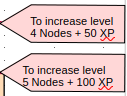
- Each level has it's own requirements to meet and level cost.
- The requirements are a number of nodes that must be acquired, be it 4, 5, or 6.
- Once you meet the requirements, you can then pay the XP cost to unlock the next level.
- Each time you level up, you get to make your Gen Dice roll for Vitality, Soul, and Power. Remember, this is based on the secondary gen dice. The primary was only for character creation.
1.2) Gaining Experience
The primary method of gaining experience (EXP) is by defeating enemies in combat. However, you can also gain EXP by things you do in the roleplay. It is really up to your GM on how to award your characters EXP.
Back to top2) Character Growth with Professions
Your character's profession greatly affects your character's growth. Through your character's profession your character can access skills and abilities. You can gain skills from within your profession and even from outside of your profession when you level up. You can however only gain abilities from within your profession. A warrior cannot learn a mages abilities after all.
Back to top3) The Importance of Acquiring Skills
While it is possible to go throughout the game without acquiring a single skill, skills are the best way to improve your character. Skills improve your attacks by increasing the damage you can do, causing status effects, and giving you more attacks. Skills improve your ability to survive attacks by increasing your defense, allowing you to wear armor your profession normally doesn't allow, and allowing you to better handle status effects. Skills improve your use of magic, and allow you to craft items and the like. While skills don't tell you how you can attack or what you can do they improve on your abilities.
Back to top4) Acquiring Skills, Abilities, and Spells
You acquire skills, abilities, and spells by purchasing the nodes in your professions node chart. For skills, you will want skill nodes. For abilities you will want ability nodes. For spells you will want spell nodes. Each node lets you acquire that thing. If you purchases a skill node, you can use it to get 1 skill in your profession. If you want to get a skill out of profession, you will need 2 skill nodes. Ability nodes can only be used on abilities in profession. Spell nodes can be used on spells, but be sure to check the page on Magic for more information.
Checks to use skills
In order to use a skill, you will need to make a successful check. This is listed as the skill's Check Roll. It may be listed as something like Normal Insight -2. This means you need to make an insight check, normal difficulty, with a 2 point penalty.
This is just a standard rule however. The situation and environment could cause for a different difficulty. For example, if you are trying to hide in a dark room this would be an easy check, meaning instead of needing to make a Normal Stealth check to use the skill you would need to make an Easy Stealth check. As always, check with your GM to make sure that the difficulty won't change for your skill use.
Once you have acquired a skill, you will fill in skill's information on your character skill sheet for that skill.
Back to top5) Using Skills & Spells
In order to use a skill, you must meet their required check roll. The check roll shows you what check is performed to perform that skill or spell. Check rolls are always listed as Difficulty, Check, and bonuses or penalties. For example, the skill Aiming has a check roll that is Easy Perceive. Easy is the difficulty showing you what you have to roll on the dice, and Perceive is the trait check. So in this case you will look at your character's Perceive, roll the d20 and add what ever is listed for Perceive to that d20 roll. If you beat the difficulty, you perform the skill. Otherwise you fail the skill. You will still spend any stat costs for doing so.
Back to top6) How to Use Abilities
Abilities are more akin to talents or feats than skills. You typically do not have to do anything to use them. Their effects simply apply to your character.
Back to top7) Dual Professions
You can have up to 2 professions at any time. To get the second profession, you simply must purchase 1 node in that profession. You cannot have more than 2 professions.
7.1) The Benefits of a 2nd Profession
Getting a second profession opens up that profession's abilities and growth to your character.
- You can use that profession's node chart as well as your own.
- You can have a wider set of weapons and armor you can use if the second profession has more freedom here than your main profession.
7.2) The Cost of Having A 2nd Profession
If you obtain a second profession, you have more nodes to spend XP on. Also you have to unlock the levels for that second profession as well. You only get gen dice rolls for leveling your main profession however.
7.3) How To Get A 2nd Profession
In order to get a 2nd profession you simply must purchase one node from that profession's node chart.
Once you have done those tasks, you now have that 2nd profession at level 1.
The 2nd profession levels when you unlock the next level on its node chart. However you do not gain gen dice rolls on your second profession.
Back to top8) How to Perform Checks
As noted in Using Skills & Spells, you have to perform the check roll to use them. You may also have to perform check rolls when roleplaying, for example making a perceive check to spot a trip wire. But how do you make these checks? It is simple, all checks are 1d20 rolls. YOu roll your 1d20 and add the number of the trait to what you rolled. That's it. So if you are making a perceive check and have a 2 perceive, and you rolled a 12 on the d20, your perceive check was 14. If you had nothing for perceive, the check would have been a 12. It is the difficulties that determine if a check is successful or not.
Back to top9) Check Difficulty
Difficulties show you how hard or easy it will be to successfully perform that check. Difficulties are Easy, Normal, Hard, and Impossible. The difficulty shows you what you must beat on your check roll.
- Easy Difficulty: must roll 5 or greater
- Normal Difficulty: must roll 10 or greater
- Hard Difficulty: must roll 15 or greater
- Impossible Difficulty: must roll 20 or greater
What you roll plus any bonuses or penalties and what is in the trait you are checking give you your total. If the total beats the difficulty, you succeed. If the total is less than the difficulty, you fail.
Back to top10) Critical Success & Critical Fails
Critical Success is rolling a 20 on the 1d20. This is also called a natural 20. If you roll this without any modifier, bonuses, or penalties, you succeed automatically. A 20 on the dice is instant success. Depending upon what you are doing, the effects or damage may be doubled as well. If this is a check to use a healing spell, for example, the healing spell will do double what is listed.
Critical Fail, also known as crit fail, is rolling a 1 on the d20. If you roll this, if a 1 is on your d20, you fail instantly. Your GM may then add in other effects of your failure depending on what is going on. Your GM may also have you make a luck check to see if your failure will still benefit you.
Back to top